Showing posts with label fiction. Show all posts

Sunday, November 25, 2012

Ellie's books 18, 28 and 31: Three Mary Russell books


I'm skipping around a bit here with the chronology of my reviews, because I wanted to get all of my gushing out in one spot. These three books are all part of the same series. (Also, side note, aren't those covers just gorgeous? I love both styles so much.)

Have I mentioned Mary Russell here before? If I haven't, I apologize, as if you know me in real life and I've spoken to you at all in the past two years there's a 90% chance I've recommended the Mary Russell books to you in terms so strong that you probably backed away slowly, smiling and nodding and looking for something to defend yourself with in case my not-so-latent maniacal tendencies started manifesting themselves in a more sinister way than book recommendations.

Ahem. Mary Russell is one of my current favorite literary characters. Laurie R. King has created an absolutely fantastic series about this British-American Jewish feminist Oxford scholar in the 1910's and 1920's who, at the age of 15, meets up with a retired Sherlock Holmes and becomes his protegee and partner. The books are meticulously researched and just sparkle with wit and intelligence. King's Holmes is his own character but still true to the original vision of Conan Doyle (although this Holmes is rather testy about any references to Conan Doyle; he dislikes the way the latter man sullied his name by association, especially once Conan Doyle turned more to mysticism and fairy stories).

But Mary Russell, from whose viewpoint the stories are told, more than holds her own with Sherlock Holmes without becoming unrealistically superior to him. He still is able to teach and mentor her without making her appear weak. She is a worthy partner for him in every way, and challenges his mind and opinions more than he has been used to.

I've read three of these books this year. The Game is book 7. Later on in the year my book club read book 1, The Beekeeper's Apprentice, and I also read book 8, Locked Rooms.

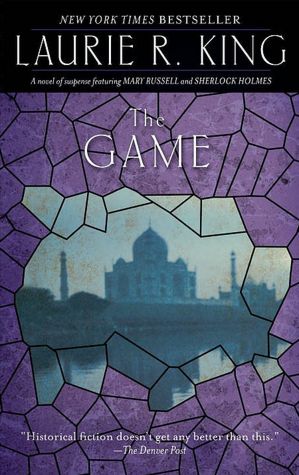
18. The Game, by Laurie R. King
****

In The Game, Holmes and Russell make their way to India at the request of Mycroft Holmes in order to investigate the disappearance of an intelligence officer by the name of Kimball O'Hara, better known as the titular character of Rudyard Kipling's novel Kim. (One of the delightful things about the Holmes/Russell universe is that many purportedly fictional characters, such as Holmes himself, are actually real and pop up at interesting times.) I loved the atmosphere of this book, which felt simultaneously menacing and full of color and spices. There were a few unexpected but satisfying twists, along with a few threads of a mystery to be picked up in the next book. All in all a solid book and great fun to read, but not quite equal to the top books in the canon (books 5 and 6, O Jerusalem and Justice Hall, were two sides of the same coin and absolute masterpieces. They were two of the top three best books I read in 2011). Four stars.

28. The Beekeeper's Apprentice, by Laurie R. King
*****

It was delightful to re-read The Beekeeper's Apprentice a few weeks later with the benefit of hindsight (or is it foresight when you know what's coming in the next few books? Anyway, I enjoyed it, whatever it was) and seeing how later events in the series were foreshadowed as well as seeing the clues to the answer to the mystery as they popped up in the book. It re-confirmed my conviction that Laurie R. King is a master of storytelling, whose writing style is like weaving a huge epic tapestry: everything is connected, somehow, and all the disparate threads come together to make an astonishing whole. (Yes, I have a serious author crush going on here.) Five stars.

31. Locked Rooms, by Laurie R. King
*****

I went into Locked Rooms not expecting too much, as I'd heard that it was four shorter stories rather than one complete novel. I was delighted to find that I was mistaken. The book is divided into four parts, yes, but that's because two of the parts are actually told using third-person narration with Holmes himself serving as the viewpoint character for the first time in the series, with the other two parts in the accustomed first-person narration of Mary Russell. This may sound like it shouldn't work, but oh, believe me, it does, and is done for very good and sufficient reasons. Far from being disappointed in this book, the ultimate result took my breath away. It stands solidly with books 5 and 6 at the top of the series. This book sees Russell and Holmes arriving in San Francisco to tie up the affairs of Mary's parents' estate, and a mystery from her childhood rises up to confront them. I can't think of anything else to say that won't give away spoilers or just devolve into garbled author-crush gushing. But seriously. Wow. Five stars and mad applause for Laurie R. King. (And yes, this book is a serious contender for the final six-star best book of the year award.)

Seriously, if you haven't started reading this series, do yourself a favor and pick up The Beekeeper's Apprentice. You should read all of them in order so you can properly appreciate the sequence and build of events and facts, and all of them, even the weakest (looking at you, book 3), are solidly on the Books You'll Be Glad You Read list.

Tuesday, June 12, 2012

Ellie's Book #11: Shakespeare Manuscript


The Shakespeare Manuscript, by Stewart Buettner

**


I picked this book up by browsing through the Kindle Top 100 selling free books list. The premise looked interesting to me—an old manuscript that appears to be an earlier draft of the Hamlet story, or more accurately, a prequel to Hamlet, shows up in a trunk of old documents and a struggling theater troupe decides to mount a production in hopes that it will bring them the boost they need. And it was interesting, and even bordered on can't-put-it-down (I really wanted to see what happened next), but ultimately it was more frustrating than anything else.

You see, one of the ground rules of writing is Show, Don't Tell. From reading the description of this book and the author's experience in writing, I don't know if he's a trained writer; I got the impression that he's something else (a theater type, maybe?) who got an idea and decided to write a book about it. I think it's also semi-self-published, which, good for him. But at any rate it seems clear that even if he is a trained writer, he missed class the day they explained Show, Don't Tell.

I'm not talking about his descriptive diction or his approach to writing individual scenes. I'm talking about plot. Put simply: too much of the action took place offstage. There were so many times in this book when MAJOR plot points were not shown; someone told us about them later in passing. I felt severely cheated in a lot of instances because even the telling tended to gloss over what I thought were important parts. One of the more egregious examples: one chapter ends with one of the major characters being rushed away from the rehearsal retreat in an ambulance. It's not until several chapters later that anyone even mentions him again and we find out what happened. And those intervening chapters are full of scenes and incidents where all the people who watched the ambulance leave are together; where it would be natural and right to explain what the resolution of that particular piece of drama is; where, in short, it feels unnatural to NOT mention it. This isn't creating an aura of mystery or suspense to serve the plot of the story; this is straight up withholding information from the reader just because you want to have a big shocking reveal later.

(It's like starting Gone With the Wind with the picnic at Tara and then skipping ahead to a scene where Scarlett, in between wondering if Rhett really loves her or that Belle Watling character, thinks in passing that he just hasn't been the same since Atlanta got burned down and everything was destroyed and I nearly starved to death in the ruins of Tara, and does he really like me or is it just in my imagination?)

Other scenes of omission (sorry; my dad is hopelessly addicted to puns and sometimes I just can't help myself) aren't as obvious, but they are just as annoying. Yes, sometimes it's a good and effective trick to show a scene through its aftermath, but you actually have to 1) explain enough of what happened in the scene that the aftermath makes sense and 2) have the aftermath actually move somewhere and have some sort of action or resolution in re: said scene. I feel like I got half of a good novel: the anguished uncertainty of love interior monologue half. There were so many words spent on what the two main viewpoint characters thought of their respective love interests that it really underscored how many words WEREN'T said about actual plot or action scenes.

Things I would love to have seen or to have had explained:

*What is up with the main character's sudden-onset agoraphobia anyway? As in, how did it get started and how is she suddenly miraculously okay enough with it to function?

*What is up with the dead brother/son that nobody ever mentions? Even when they finally get to this explanation, it isn't explained.

*What was the horrible thing the professor said to the love interest that caused the major insurmountable fight that is then surmounted in roughly two minutes of interior monologue?

*What's the backstory between main character and skeazy actor? It's mentioned so many times that there IS a backstory but we are NEVER given any details.

*Did the wife really flirt with the brother-in-law or was the husband just really drunk?

*Where the heck did that divorce come from? (Oh, wait, left field is where.)

*What happened after said divorce came out of said left field?

*Why is main character still fighting with older brother? Why does older brother put up with it? Why does he work for a politician?

*While we're at it, what's the deal with brother-in-law? Or with secretary? Or with any number of people, all of whom seem to be important cogs in this book and have important scenes that ALL HAPPEN OFFSTAGE?

*Is British bookseller actually creepy or is it just the aftereffects of crazy dad's amnesia?

*Who really wrote the manuscript? (Actually, this one I was okay with the ambiguity on—this book is more about the waves the manuscript causes than the actual manuscript itself. It's just that, with all the other stuff that got left out, I felt like maybe the author could have thrown us a small bone on this one.)

In short: just because one character gets major amnesia doesn't mean you have to make the reader feel like she also got amnesia and forgot half of the book.

I can only give this book two stars, which really makes me sad, because I wanted so badly to like it and because it really was gripping enough that I read it straight through in a fever of wanting to know what happens next. But if a book refuses to tell you what happened before, what's happening now or what happens next, the best premise in the world can't save it. Two stars.

Tuesday, June 5, 2012

Ellie's book #10: Life of Pi


Life of Pi, by Yann Martel

***


Surprisingly, this was not a re-read for me. I know this book has been around forever and I had been hearing of it for a long time. What may be more surprising, though, is that with all the buzz, I really didn't know anything about the plot going into this book. I picked it up as a Kindle Daily Deal (oh, KDD, how I love thee!) because I like buying titles I recognize for cheap as free.  

I feel that a little context is necessary for my review. The week before we made the big cross-country move, my husband was already in Florida getting things set up and starting his job. I was back in Utah packing up everything and taking care of our 18-month-old son, who decided to get RSV exactly eight days before we were scheduled to fly out and two days before my husband was supposed to come home to help me with the final arrangements and such. Long and harrowing story short, I ended up spending a very long and very bad night in the hospital as they monitored my son's breathing and heart rate (fortunately they didn't end up having to put him on oxygen and he was better enough to go home the next day). I got very little sleep, due to both the assorted blinking and beeping coming from the monitors and an overabundance of worry from various sources, listed here in roughly descending order: 1) my son, 2) the fact that my husband was out-of-state, 3) the fact that I didn't have time for this emergency what with the tight packing schedule, 4) the fact that I was moving cross country soon, and 5) the fact that I was hungry and thirsty and suspected that the hospital staff had forgotten their promise to bring me some cheese and crackers and a cup of ice water.

To try and get my mind off of these various issues, I started reading a new book on my Kindle app on my iPhone, and happened to choose Life of Pi. Thus I did not start reading it in the most auspicious of circumstances, nor did I finish reading it in the most auspicious of circumstances. Turns out that a toddler with RSV tends to pass it on to you if he coughs in your face repeatedly because he's too exhausted to turn his head away from you and is so sick and sad that you can't put him down for more than 30 seconds at a time. So, three days after our hospital stay, I was fighting through RSV myself while packing up two moving pods. Fortunately my bout did not require any hospital time, but I did spend the bulk of the next day curled up with my iPhone on an air mattress, a lump of pathetic misery, finishing this book. (Needless to say, this move was not the smoothest or most organized one we've ever made.)

But as for the book itself: I liked it. It was able to distract me enough from the crappy situation I was going through and entertain and even uplift me. My favorite part was the description of the events leading to Pi's becoming a devout follower and active practicer of three different religions at once (Hindu, Islam and Christianity). I loved his descriptions of his first encounters with other religions and how he came to love his two adopted religions as well as the religion of his birth. I wish that this theme had been kept up a little more throughout the section on the Pacific Ocean. Not that the Pacific Ocean wasn't exciting and enthralling as well; but it didn't have the heart of the book that I had fallen in love with at the beginning, the tripartite faith of this young man.

Like The Princess Bride, this book is written as a frame story, with the narrator ostensibly interviewing an older Pi about his life story. Since, as I said, I knew basically nothing about this book going in, and my Kindle edition didn't specifically say "A Novel" on it, I wasn't sure at first if this was fiction or non-fiction. It added another layer to the reading experience for me, wondering if it was actually true or not. I know that part of the point of the book is to look at what is or isn't true and choose the story that means the most to us, but it still was sad to determine for certain that this book was fiction after I finished reading it, and I think that revelation made me like it a little less than I had. That's not really fair to the author, of course; but that's the way it is.

All in all, this book was a solid good read and a much-needed distraction for me during that last horrible week before the move. I don't know if I would have liked it more or less if I'd read it in different circumstances, but as it is I can recommend it as a good book, as long as you don't get too squeamish (certain of the lifeboat scenes are a bit gruesome). Three stars.

Friday, May 4, 2012

Ellie's Book #8: The Woman in White


The Woman in White, by Wilkie Collins
****


This was a re-read for my book club, but it's a book I love. The first time I read this book, I was reading it online on Project Gutenberg during my breaks at work. My husband and I were getting ready to move around this same time, and the move date (when we'd be without internet for a couple of days) coincided with my reaching the part where Things Start to Get Really Good. I was also going to be taking a couple of days off work for both the move and my little sister's wedding (yeah, I know, we have *great* timing), and I could not bear the thought of waiting that long to find out what happened, so I ended up taking time out from packing to run to three bookstores to find a copy because the first two were out. 

And I'm glad I did. I think this was my fifth read of this book (yeah, I re-read a lot. I'll discuss that in another post sometime) and the first time reading it with the specific plan of discussing it with other people, so it was fun to see what themes I picked up on this time that I had missed before or forgotten about. 

This book is an early mystery novel of sorts, involving a strange woman in white, two half-sisters, a drawing teacher, a brutish baronet, an invalid uncle, assorted old ladies and a sinister count. Add mistaken identities, lunatic asylums, trained white mice, kidnapping, doomed love, sea voyages, attempted murder, arson, forgery, slander, scandal, and opera-loving Italians of all shapes and sizes to the mix and you have the makings of 400-ish pages of a whole lot of fun.

What can I say? I can't really sum up the plot of this book succinctly, partly because Collins is anything but succinct. It's told as a series of first-person narratives, ostensibly so that no part of the story is given second- or third-hand; each part of the story is related by an individual who was actually there to see it or take part. This is great but it means that when Walter is telling the story we have to listen to a lot of extraneous matter about how wonderful and beautiful and perfect Laura is, and when Marian is telling the story we have to listen to a lot of (unconvincing) regrets about how she can't do anything to save them because she is only a weak woman.

Let me take a break here to say the lady doth protest too much. Wilkie Collins, in Marian Halcombe, appears to have created a character he didn't quite know what to do with or how to control. She's smart, she's sassy, she's resourceful, she's basically awesome, but he needed Walter to be in love with Laura instead, you know, for plot reasons, so it feels like he had to keep artificially hobbling Marian to keep her from becoming the main love interest. To do this he specifies that she is ugly (yes, he even goes so far as to give her a bit of a mustache) and keeps having her remind us all that she is only a woman, and what can women do? A heck of a lot, Marian, as you keep showing at every turn. Seriously, Laura's great and all, but you're the heroine of this story in my book and only the VILLAIN has the sense to see it. Yeah, you read that right, the hero is in love with bland and actually-helpless and feminine to the core Laura, while the villain has the good sense to fall madly in love with spunky Marian.  (Actually, in the not-really-faithful-at-all 1930's movie adaptation, the filmmakers DID make Marian the main love interest, kind of the same way that people can't help but tinker with Fanny Price. This was possible because in the movie Marian did not have a mustache.) 

Wilkie, your character was too good for you, and I hope you realize it. (I think you do, because you do have Walter, in his brief pauses between rhapsodizing on Laura's perfections, mention how amazing a person and what a staunch ally and good friend Marian is. And hey, she's the one he takes into his confidence when plotting! Seriously, the only thing keeping this woman from taking over the show is that tacked-on mustache. In my mind I see it kind of like a Mr. Potato Head accessory; just shoved on there as an afterthought once the author realized that he'd painted himself into the corner where his reader was naturally going to be rooting for the hero to get with the wrong girl.)

But even with these flaws, I still really enjoy this book. It's long; it's an investment and fun to curl up with knowing that you'll be taking a long journey together. And the good news is that (other than the aforementioned rhapsodizing and self-deprecation from our respective main characters), there isn't much wasted space (okay, okay, so a few of the landscape descriptions could also have been dropped). What I mean is, all the PLOT elements come back together; even what seem like throw-away bits end up being important to the story later. 

If you can get past some Victorian stereotypes, can tolerate unnecessary facial hair, and like fun mystery-type stories, I recommend The Woman in White. It's worth it, I promise. (Seriously. Just wait till you meet Fosco. He must be seen to be believed.) Four stars.

Monday, April 30, 2012

Ellie's Book #7: Midnight in Austenland


(Side note: Apparently Blogger went and changed everything while I've been away. Does anyone else seriously dislike the new blogging layout? I can't find ANYTHING.)

Midnight in Austenland, by Shannon Hale
****


Let me just get this out of the way to begin with: My friend Tracy (name changed) would probably hate this book.
Let me back up a bit.
Shannon Hale's Austenland* is one of my go-to favorites for frothy and sweet but not stupid reading. I love Jane Austen, I love Shannon Hale, I love Colin Firth, I love romance and happy endings. I think Austenland was the first book I actually bought for my Kindle (mostly I just loaded up on freebies); I loved it enough to want to buy it again to have easy access to it all the time. It's basically a one-long-sitting read and cheers me up every time. I even had my book club read it after we'd finished all the Jane Austen books, and it was enjoyed, even if not all of them loved it like I do. 
Fast forward a few months from that book club meeting. I'm sitting at work one afternoon with my friend K, who is also in the book club, and our friend Tracy walks in. Without preamble, she declares to the room, "Have you ever read Austenland? Don't. Worst book ever." 
This isn't the only book we emphatically disagree on. She loves Eragon. She hates Jane Eyre. I think her main complaint with Austenland is that it *SPOILER ALERT* ended happily. (I sometimes wonder if she also hates puppies and sunshine. Not really. And I love her dearly. But that Jane Eyre thing makes me worry sometimes.)
Anyway. Midnight in Austenland is the, well, not really sequel, but follow-up to Austenland. It takes place in the same setting—a fictional resort in England where rich women pay fabulous amounts of money to have an immersive Jane Austen vacation experience, complete with handsome actors in breeches whose job is to make the guests feel enchanting—but most of the characters (with a few sparkling exceptions) are different. While Austenland took its inspiration more from Pride and Prejudice, with healthy doses of Persuasion and Mansfield Park thrown in, Midnight is most closely allied with Northanger Abbey. It's basically Shannon Hale's nod to the Gothic novel and is more of a mystery novel than a romance, although it also *SPOILER ALERT* ends happily. (Sorry, Tracy.)
This book features Charlotte, a successful entrepreneur who discovered Jane Austen's books after her husband left her for a woman named Justice. (Yes, really.) Her two children are spending a few weeks with their father during the summer and she decides to take her first vacation in years. A casual mention of Jane Austen to her travel agent ends up with Charlotte booking a two-week stay at Pembrook Park. Once there, she begins to lose track of what is real and what is only make-believe, and she must decide whether she actually has uncovered a sinister mystery or if it is only part of the entertainment.
I love Shannon Hale's voice and the way her books make you feel like a member of a cool little club with the narrator's sly comments and the inner monologue her characters carry on. She is witty and intelligent and obviously having a whole lot of fun writing these books. But I also enjoy these books because although they are firmly planted in the "just-for-fun" category, they're actually well written and smart. There's substance going on; they're not just cotton candy. They're well researched and stand on their own rather than being mere derivative fanfic. They're definitely more frothy than most of her other books, so if you're coming to these books expecting the beautiful literary prose tone of, say, The Goose Girl, you might be disappointed. But the writing is still excellent and well-crafted and the humor is great, and the characters are ones that you wouldn't mind curling up and spending an afternoon with. 
I'd recommend reading Austenland first, just because I love it and it gives you a bit of perspective on some of the events of Midnight in Austenland, but Midnight can stand on its own quite easily if you haven't read Austenland (or, you know, if you trust Tracy's judgment more than mine or if you hate happiness and butterflies). Four stars.

P.S. In the interest of full disclosure, there are actually many books on which Tracy and I agree; I'd be willing to bet that in most instances trusting her judgment wouldn't be all that different from trusting mine. 

*Brief synopsis of Austenland for those who are interested: Jane Hayes is a thirtysomething with a string of bad relationships and an unhealthy obsession with Mr. Darcy as played by Colin Firth. Compared to Darcy, real men just don't stack up. When Jane's great-aunt dies and leaves her an all-expenses-paid vacation to Pembrook Park, a Jane-Austen-themed resort, Jane decides that maybe this will be the best way to kick her Darcy fixation for good. 

Ellie's Book #6: The Princess Bride

Yes, I'm back. The cross-country move went well but the dust is still settling so I'll be playing catch-up for a bit. 


The Princess Bride, by William Goldman
*****


This is my favorite book in all the world, though I have never read it.
So begins one of my favorite books, The Princess Bride, by William Goldman. This book has been a source of both happiness and confusion to me since I was a young child.

I should explain. As you may have caught on, I'm a bit of a movie geek. Yeah. I'm the one who can rattle off actor resumes and Bacon scores faster than IMDb. If you don't understand a comment I just made, there's about a 75% chance that it's a quote from a movie (and an 80% chance in that case that it's a movie you've never heard of, let alone seen). I, like my father before me, stay until the end of the movie in the theater, not to see if there are any extra scenes, but to read the credits. (The advent of extra scenes, however, has really helped to convince the people with and around us not to bug us to leave early. True story: my parents were once asked to leave a movie theater. They had gone to a late showing of the Disney classic Alice in Wonderland—the real one, not that Tim Burton nonsense—and were the last people left in the theater because my dad was watching the credits. The cleaning staff just wanted to go home so they asked my parents to leave.)

But I digress.

The Princess Bride was one of the first movies I remember seeing in the theater. There was an old dollar theater near our house called The Arcade, and that's where I remember seeing such movies as The Rescuers, Peter Pan, Lady and the Tramp (I chose to see that for my birthday movie, probably when I was three or four, and the projector broke), The Little Mermaid and, of course, The Princess Bride. I loved that movie. When it came out on VHS my aunt got it, whereupon she was the most-requested babysitter at our house in spite of the fact that she lived nearly an hour away. One of the best days of my young life was when The Princess Bride had its network TV broadcast premiere and my dad recorded it so that now we had our own family copy (the downside was that this was the copy I was most familiar with growing up and so I was surprised when I went to college and got my own copy of the movie and there were parts in there I didn't recognize because the TV version had been edited to run in the time allotted. I made up for it, though, and three years later actually became the campus champion of Princess Bride trivia. No, I am not kidding. My prize: a Princess Bride frisbee full of gummy worms, which the event organizers called "shrieking eels." The reason I chose that prize was because I already had a copy of the movie, the book and the soundtrack, which is not surprising when you consider how I wound up knowing all that trivia in the first place).

But (coming back to the aforementioned confusion) my mom had raised a question when I was little that had always made me wonder. In the movie, when the grandfather starts reading, he says, "The Princess Bride, by S. Morgenstern. Chapter One." But in the credits, my mom pointed out that it says it's based on William Goldman's book. Which is the real author?

The real author, of course, is William Goldman. But his book is ostensibly "the good parts version"—that is, he's writing it as though he's abridging S. Morgenstern's longer book, just keeping the good parts and getting rid of all the boring political satire that Morgenstern supposedly stuffed into it. But it's done well enough that when I first read this book in the sixth grade (no, this isn't a children's book), I really did think there was an unabridged version floating around out there. I'm not sure how long it took me to figure out the truth, but much longer than it probably should have. (I'm guessing somewhere around my junior year of high school is when I finally accepted the fact that I would never get to read the hat-packing scenes. It's kind of like learning about Santa.)

But coming to the book itself—it is simply wonderful. The movie, excellent as it is, doesn't half do it justice. I still, to this day, am disappointed while reading the passages from the Zoo of Death because they're not in the movie and it would have been so cool to see them! And then I remember that I don't like seeing pictures or video or real life of snakes or spiders and think, well, okay, the Pit of Despair will do. But I still use the Zoo of Death passages as great examples of suspense and good writing in classes. I also love how much more back story you get with the characters (young Inigo listening to Domingo and Yeste in particular gives me the giggles), and I have to say that it's much, much easier to understand the dialogue in the movie's swordfight scene once you've read the book.

William Goldman is an excellent writer in every sense. You're probably familiar with his work even if you don't realize it—he's an amazing and successful screenwriter as well. Think Butch Cassidy and the Sundance Kid, All the President's Men, Misery, Maverick, and of course The Princess Bride. But this book is a marvel of creation and of construction. Everything fits seamlessly together, especially the way he uses the frame story of the abridgment and his father first reading the book to him when he was sick as a child to actually help tell the story. Writers should study this book to see how a master crafts a story.

It's come to the point where I don't know for sure which I've done more, read the book or watch the movie. But it had been a long time since my last re-read (I know because I found a ticket stub to Harry Potter and the Prisoner of Azkaban tucked inside my copy when I opened it), and I needed something familiar, comforting and lighthearted-but-not-stupid after the emotional wringer that was Wintergirls. The Princess Bride did the trick very nicely, like a long conversation with an old friend, the kind where you both end up laughing so hard you can barely breathe.

All I can say is, if you have never read this book, please do yourself a favor and pick up a copy as soon as possible. It is one of the most well-crafted novels I have ever read, and it's entertaining and witty on top of it, which, really, is everything a book ought to be. Five stars.

Monday, March 5, 2012

The Guernsey Literary and Potato Peel Pie Society

I'd give this one 3.5 stars. It was a sweet, easy read. If you had a lazy day, you could finish it in a few hours.

It's about a writer, Juliet, who receives a letter from an unknown man living on the island of Guernsey (in the Channel Islands), which had been occupied by German troops during the WWII. Set immediately post-war in London, it's a charming story written entirely in letters exchanged between Juliet, her publisher, and her friends on Guernsey. Dawsey, the unknown man, sends her a letter when he finds her name referenced on the back of a Charles Lamb book, and seeks more literature by said author.

The two begin exchanging letters, and through their love of literature, form a chain of endearing friendships based on the Guernsey book club that helped them survive the occupation, which change many lives.

The writers create likable characters and a surprisingly well-crafted storyline considering the medium of correspondences. References to some of my favorite Jane Austen characters and an underlying love story held my interest to the end. Not a groundbreaking book, but one worth reading one day.

Tuesday, February 7, 2012

Kristen's 4th Book: Jonathan Strange and Mr. Norrell


It's a rare pleasure to read a book as imaginative and well-written as Jonathan Strange and Mr. Norrell.

I knew nearly nothing about the book going in, as I received it as a Christmas present. My husband chose it from a list of reads recommended by one of his favorite sports bloggers, Keith Law. Incidentally, Mr. Law is a thoughtful and interesting writer who reads a ton. His list of the top 100 novels he has read is worthy of a perusal. There's quite a range. Additionally, his review of this particular novel is great.

Anyway. The book is a hefty tome, or rather would have been had I received a physical copy. In paperback, it's more than 1,000 pages. It took me the better part of three weeks to finish. Published in 2004, it was written by British author Susanna Clarke and is her debut novel.

I hesitate to give too much background, as part of the pleasure of the read is in the discovery of the world Clarke has created. As many of my favorite books are *cough Jasper Fforde cough*, Jonathan Strange and Mr. Norrell is set in England in a parallel reality. In Clarke's English, magic exists and English magicians practice magic. No dragons and alchemy, but a rich history of faeries and faery kings and practice of magic that shapes the history of England.

The events of the novel take place in the early part of the 19th century, and the tone/style of the novel is decidedly Victorian, with some gothic/Austenian overtones. In some respects, it reads just like a Dickensian chronicle of the history of English magic. Indeed, this book is written at least partially in the manner of a history book, complete with footnotes. While footnotes as a general prospect can be tiresome, I urge you to take the time to read them in this book. They are some of the cleverest, most inventive, and sometimes hilarious parts of the book. It was easy on my Kindle edition of the book because I could just pop to and fro.

As I said before, it's a long book. Parts of it felt a bit ponderous to me, though unlike a Dickens novel (as an aside, happy birthday, Mr. Dickens!) there's a relatively tight cast of characters for its 1,000 pages. It took me awhile to get through the first third of the book, which is still fun and creative but not nearly as fast-paced as the later parts of the novel. Some of that is perhaps a reflection of its focus on the distinguished Mr. Norrell. (Dear self, don't give too much away). And as it turns out, it takes a fair amount of exposition to establish a parallel universe wherein magic has been celebrated and practiced since the beginning of time (and before then, if one happens to be a faerie).

A dark humor interweaves the pages that very much appealed to me. Jonathan Strange and Mr. Norrell is never outright frightening, but I did experience a bit of the unease that the characters experienced when encountering faeries, who as it turns out are no Disney Tinkerbells. Nor are they Cornish pixies, but that's another review.

In my opinion, it's a book that's worth the investment, particularly for those with any interest in Victorian Britain (though there's also some time spent in war-torn Spain!) and Victorian literature. This certainly includes most of the bloggers here. The writing is fabulous, and it builds up to a singularly satisfying finish.

I vacillated on whether to give Jonathan Strange and Mr. Norrell four or five stars until I had read the last 50 or so pages. I liked how all the little end bits were resolved so well that the ending bumped it into the five star threshold.

And now that the time investment is over, I'm left feeling a little forlorn and just a tad lonely. Books like this one usually leave me feeling that way.

Tuesday, January 31, 2012

Ellie's Book #5: Wintergirls

Wintergirls by Laurie Halse Anderson
*****


How do I write a review of this book?

A week later, I'm still shaken by it.

I read Laurie Halse Anderson's Speak last year and loved it. I cried when I finished it—beautiful and cathartic tears. It hit me in a way that a lot of books don't. It was definitely a five-star read for me.

I've decided that Wintergirls is a five-star read, too, but it took me a long time to make that decision.

Wintergirls is no less powerful than Speak. In fact, I'd say it packs an even stronger punch, although I hate to use such a clichĆ© for such a book, even though I can only think of clichĆ©s to describe it. Kick in the gut, brick to the face, hit by a train, knock the wind out of you, rip you open—pick your own description here, that's what this book did to me emotionally. I couldn't put it down even though it was, simply put, terrifying.

The book begins with Lia, a high school senior, being told by her stepmother that Lia's best friend Cassie was found dead in a motel room. Cassie and Lia haven't spoken for six months, which is why Lia didn't answer her phone over the weekend when Cassie tried calling her thirty-three times, and now Lia is haunted by the idea that somehow she is responsible for Cassie's death.

Which sounds simple enough, and rough enough for a book premise.

But.

The reason Cassie and Lia haven't been close is because Cassie's parents made her stop talking to Lia after Lia's second stint in rehab for anorexia. The first stint happened after Lia blacked out while driving Cassie's car because she didn't have enough food in her system and when the paramedics got there her blood pressure and body temperature were only just this side above dead, and Lia's secret was out. Cassie wasn't even scratched and so her secret eating disorder, bulimia, stayed secret and she stayed popular and cut off Lia as "a bad influence."

Until Cassie winds up dead in a motel room.

Honestly, I have never read a book this intense, where the heroine seems absolutely determined to destroy herself slowly and systematically. Nearly every time a food is mentioned, Lia tacks on the number of calories in parentheses. She often speaks in strikethrough font, so you can see the war between her body and her mind as she slowly and determinedly tries to starve herself down to 99, 95, 90, 85 pounds and lower, all while hiding that fact from her family so they won't send her back to the hospital. "I take the cup [of orange juice] from her. My throat wants it my brain wants it my blood wants it my hand does not want this my mouth does not want this."

I had no idea until the very end whether Lia was going to make it or not, and it was a sick-making kind of feeling to watch her spiral downward out of control and not be able to shake her awake, or wave my arms in front of her parents' faces and say "How are you not seeing this?" or heavens, just shove a cupcake down her throat or do something, anything to get her or anyone to see the madness and stop it. It was not a comfortable book to read.

And yet I couldn't put it down. I read it straight through and felt absolutely depressed for most of the rest of the day as I processed it. Anderson's writing style is gripping and immediate and visceral, and you really do feel like you're living through the experience yourself, which, as I said, is not a comfortable thing. But there is no doubt it is well written.

I don't know if I liked this book or not. I do know I won't forget it any time soon.

And I think that I'm going to have to recommend it to people to read. Not like Speak, which I think everyone should read, period, no exceptions. But I think that some people should take the opportunity to read Wintergirls because even though it's not a comfortable experience, it is a powerful experience, and one that will change you.


(And if you do read it, I'd love to discuss it with you.)

Wednesday, January 18, 2012

Ellie's Book #3: I Capture the Castle

I Capture the Castle, by Dodie Smith
*****


I have been meaning to read this book for some time, and was spurred on by several references that Kristen has made to it in the past few months. (I would claim that I also picked it up because the author also wrote The Hundred and One Dalmatians, the book upon which my son's favorite movie is based, but I have to admit that despite seeing Dodie Smith's name in the credits as often as I do, I didn't make that connection until I glanced at the author bio in the back of the book. Movie recognition fail.)

This book hit me in a funny way that I can't quite describe. I was pre-disposed to like it based on what I'd heard about it and also the fact that I approve of plots that resemble Austen in general. (People often mistake Jane Austen books for romantic comedies, which is true to some extent, but that misses the HUGE undercurrent of the do-or-die struggle that is the Regency marriage game.) And I did enjoy it, but it went deeper than that.

The Mortmain family is living out their 40-year lease of an old castle which has fallen and continues to fall into disrepair. They are in a state of not-so-genteel poverty, although the grinding hopelessness of their situation doesn't really crash down on the reader as it might because it is held at bay by the wonderful personality that is the narrator, Cassandra Mortmain. Can I just say that I love her? I love her in the way you love a sister or a best friend (or, occasionally, yourself), who you cheer for and laugh with and who makes you tear your hair out when they do really stupid things that you can't save them from and which you know they are better than. I loved her voice, the way she frequently stops to take stock of herself and her feelings, and her determination to be fully honest with herself in the journals she's keeping.

Cassandra's older sister, Rose, out of desperation, determines to marry strictly for money. I get this. I remember a time during law school when my husband and I did the calculations and said unless something can change and soon, this is the day we will run out of money. It's a terrifying, suffocating feeling, and you get just enough glimpses of it through the lens of Cassandra's plucky (but not foolish) optimism to forgive Rose for deciding to do whatever it takes to never be in that situation again. And for the record, I like Rose a lot better than I ever liked Scarlett O'Hara, who made a similar vow.

I had more problems with Mr. Mortmain, the father of the family. For reasons I (and the other characters) can't quite fathom, Mr. Mortmain fritters away his time and talents NOT writing his second book for years as his family sinks farther and farther into the above-mentioned poverty. I was frustrated that he could be as callously oblivious as he seemed to be to his family's bleak situation. (Although I have to confess that from the descriptions of the book he wrote, I wouldn't want to read it myself.)

The rest of the cast of characters are worthy of this book in every way. Dodie Smith has a gift for characterization that makes you feel as though you know these people, or might run into them at any moment.

The book was extremely well written, and I loved reading it. I'm not sure that I liked finishing it, though. In order to explain, I may need to get ever-so-slightly SPOILER-y, although I won't give away any main plot details.

This book wormed its way into my heart, and I wanted nothing more than good things for Cassandra especially. I wanted her to be happy. And in the end, it felt like I hadn't quite gotten that for her, and had to settle for her being smart instead, with the hope that happiness would follow sometime in the future. The ending was almost devastatingly effective for me, rather like a kick to the gut, in that even though it was a good ending as far as being hopeful and as far as the welfare of the characters was concerned, I felt every bit of the ache that Cassandra must have been feeling, and it stayed with me long after I finished. It's taken me a few days to come to terms with it and write the review.

That being said, the book was absolutely worth that kick in the gut. I'm not sure how soon I'll want to re-read it, knowing what's coming (because who likes being kicked all the time?), but I'm betting it will eventually go into my re-read roster.

Let me reiterate that it's really not a depressing book and that nobody gets eaten by the eels at this (or any other) time. But if you tend to fall into deep smit with fictional characters and live their lives vicariously, be warned that this one is going to be a bit of a ride.

In short, this book truly was extraordinary. I'll be feeling it in my bones for a long time to come. Five stars.

Sunday, January 15, 2012

Book #3: The Game, Book 7 in the Mary Russell series


I also read Miss Pettigrew, but have no need to rehash Ellie's thoughtful review of a lovely little book. Pettigrew was my second book of the year, and I've decided to track how many I read simply because I never have before. It'll be interesting to see the body count after the year's up.

Speaking of Ellie, she also got me turned onto the Mary Russell series by Laurie R. King. I've been burning through them, and they are delightful.

Truthfully, I don't usually read mystery series because they can become a bit wan and kitschy. (The fact that I read a lot of the Cat Who series when I was younger may have something to do with this jaded view of mystery novels.) I like this series even more as I go along, which is refreshing.

For a bit of background, the character Mary Russell is a half-Brit, half-American, Jewish feminist orphan. Yeah, I know. But it works. It works marvelously. In the first book of the series, The Beekeeper's Apprentice, 15-year-old Mary encounters the semi-retired Sherlock Holmes who keeps bees in Sussex. They become nearly instant friends, and eventually Mary becomes his apprentice (ergo the title). Their adventures together land them in all sorts of troubles both in solving crimes and as instruments of the political machinations of Mycroft, Sherlock's older brother.

The writing is excellent, and entirely told from the first-person perspective of Mary Russell herself. Although the author is the first to emphasize that these are Mary Russell books not Sherlock Holmes books, they are one of the better bits of derivative literature I've chanced to stumble upon over the years. Ms. King is very thorough with her research and is true to the essence of the world established by Sir Arthur Conan Doyle, while making the character of Mary her own.

Unfortunately, to delve much more into the background of the books would be to deny potential readers the pleasures of discovering the world of Mary Russell and Sherlock Holmes themselves.

In The Game, Russell and Holmes find themselves in India of all places. (This is far from the only random exotic locale the pair finds themselves.) It's a lush and lustrous romp, full of interesting characters and part of the plot dependent on characters from Rudyard Kipling's Kim. Disguises, deceit, dangerous beasts, and political intrigue in a time of political unrest in the British-occupied country weave through the novel. I hesitate to give too much away, as this is the next book in the series for Ellie and I don't want to ruin it for her.

I liked it a lot. It's not my favorite of the Mary Russell books I've read so far, but that's largely because of how much I loved the two companion books in the series, O Jerusalem and Justice Hall. My appreciation of the book may have been enhanced if I was at all familiar with the book Kim, though I think Laurie King does an adequate job explaining the connections for someone unacquainted with the book or the character.

A solid offering in the series. I've yet to finish one of the books and not be curious what happens in the next one. And I'm especially glad that there are still quite a few more books to dive into, so expect more reviews from this series as the year progresses.

I'm giving this four stars. It was a fun and pleasurable read as the Mary Russell books always are. Definitely give The Beekeeper's Apprentice a chance if this piqued your interest at all.

Just the facts, ma'am
Author: Laurie R. King
Published: 2005
Rating: 4 stars

Friday, January 6, 2012

An Introduction and My Book #1: The Handmaid's Tale

Hello, fellow bloggers and readers. I'm Kristen. I'm a reader and an editor and chaser of a very active six-month-old baby boy. Growing up, I was that kid who spent recess reading books. I'm not shooting for a specific number of books to read this year, but I still read a lot and look forward to a year of interesting book discussions.

Onto the main event: The Handmaid's Tale


Amazon does a daily deal for Kindle—namely, some deeply discounted book or other miraculously sent to my e-reader. The Handmaid's Tale looked reasonably interesting, so I indulged in a $0.99 splurge.

To quickly cover the basics, it was written by Canadian author Margaret Atwood and published in 1985. It falls under the category of dystopian or speculative fiction. (As an aside, is it morbid how much I usually love dystopian novels?) The author derived the title from "The Handmaid's Tale" in Chaucer's Canterbury Tales.

In the dystopian world established by Atwood, the government has been overthrown by a fundamentalist religious group which calls itself "The Sons of Jacob." Any bank account owned by a woman became frozen—suddenly, women had no status or recognized rights except through their husbands. For the common people, society functions somewhat in a communistic format. People are given tokens that represent rations of food and other supplies. On a monthly basis, random people are executed as an example.

Presumably due to radiation and other environmental grossness, fewer and fewer women are capable of conceiving and carrying a baby to term. The radiation can cause infant mutations and other unpleasantness. The remaining fertile women are rounded up, permanently separated from their families and children, indoctrinated, sometimes tortured, and forced to become Handmaids. Handmaids are in essence sexual slaves passed around the upper echelons of society to both continue the human race and to provide children for the wealthy classes of society. The Handmaids live as pariahs and concubines, given three chances with three families to conceive and bear a child before being shipped off to the ambiguously named "Colonies" for a life of hard labor.

The main speaker throughout the novel is a Handmaid. Her name is Offred, a patronymic name given to each of the Handmaids that consists of the word "Of" and the first name of the man she serves (thus, "Of + Fred"). Any time she goes in public, she must wear red robes that sound like a combination of a nun's habit and a hijab. Her story isn't a happy one, and the whole book is rather depressing even for a dystopian novel.

Did I like it? I'm not quite sure, really. I found it interesting. It isn't a pleasure read by any means. Even fairly restrained depictions of the monthly "Ceremony" wherein the Commander has sex with Offred while Offred lies in the Commander's wife's lap (yep—that adds a whole new dimension to the idea of a threesome) made my stomach turn.

I find the societal implications also interesting, as well as the exploration of the underground resistance movement. If I hadn't gotten it for less than a dollar, I'm not sure I would have read it. I do find it fascinating how understated the horror of the book is. I think it's intended to indicate the result of indoctrination. Much of the writing is simply observational, without commentary on how horrible their lives all are. It's at least effective in that respect.

The novel ends ambiguously, which was fine for me. I would imagine those who favor neat tidy Victorian endings with the bad guys punished and the good guys avenged will hate the ending. The ending does give some hope for humanity without seeming phony, which I did appreciate.

I'd say read it if you get around to it. Thus, I'm giving it 3 stars under Meg's rating scale. I wouldn't enthusiastically recommend it, nor discourage anyone from reading it. The Handmaid's Tale is certainly thought-provoking and reasonably well-written. It's a quick read and for all its unpleasantness, I wanted to find out what happens. That's more than I can say for a few books I tried to read last year.

Wednesday, January 4, 2012

Say hello to Ellie and also to Miss Pettigrew.

Booyah!

It's maybe a little sad that your first introduction to me on this site is where I'm doing a celebratory dance that I was the first to finish a book. I'm really not this annoying in real life, I promise. (Or at least I hope I'm not. Those of you who know me in real life, feel free to not disillusion me on this point.)

Anyway. I'm Ellie. I read, I write, I edit, I breathe (usually). I love old movies, and I love new movies. I spend most of my time hanging out with my toddler son and my husband. I have another book blog where I'll be doing various other posts this year, so if I haven't scared you off yet, feel free to wander on over there and watch the madness continue.

But the important thing here is that I finished reading my first book for the year. To be fair to the others, it was a very quick read and one I've read before (I was re-reading it for my book club). On to the review.

Miss Pettigrew Lives for a Day, by Winifred Watson.
****


This book is absolutely delightful. It reminds me of a big, lavish Fred Astaire musical in terms of both tone and wit. It's frothy and fun and I wouldn't be surprised if a Busby Berkeley number popped out from between the pages at any moment. This is the perfect kind of book for a rainy day, when you need a little pick-me-up, or a sunny day, when you need a book that's in keeping with the weather, or for any kind of day in between. Unless you hate puppies and sunshine and people having fun, you will most likely enjoy this book. (Note: this book does not actually contain puppies.)

Miss Pettigrew is a middle-aged, dowdy, down-on-her-luck, timid, perpetually-seeking-employment spinster of a governess, and the daughter of a clergyman to boot. She begins her day at 9:15 a.m. by going to the employment agency, where she is given word of a possible position. She heads over to the home of Miss Delysia LaFosse, uttering a little prayer before she rings the bell, admitting to God that it's her last chance, and they both know it.

Little does Miss Pettigrew know that by ringing the doorbell at Five, Onslow Mansions she is heralding the start of one bright, golden, adventurous day. In the glittering world of Miss LaFosse (a decidedly non-clergyman's-daughter-type actress), Miss Pettigrew is given the chance to act the heroine, save a damsel in distress, reunite young lovers, eat delicious food, play dress-up, incite a night-club fight and even (gasp!) wear make-up and curl her hair. What would her strictly proper, strictly conservative, dearly departed parents say if they could see her now? And what would her new acquaintances do if they knew what she really was—only a lowly governess, and not a very good one at that? And how on earth will she be able to settle down to her dull gray existence after living for this one spectacular day?

I have to say that my favorite thing about this book is the snappy dialogue. It feels just like a rapid-fire comedy from the era of early talkies (and was supposed to have been one. several motion picture studios had their eye on this book, and the rights had even been acquired, but for one reason or another the project kept getting delayed. The film version wasn't made and released until 2008, with Frances McDormand and Amy Adams. I highly recommend the movie, too, although it doesn't follow the book exactly. But how could you resist Lee Pace or Ciaran Hinds? That's right. You couldn't). My favorite passage involves this exchange between Miss Pettigrew, Miss LaFosse, and one of Miss LaFosse's several suitors, regarding another of her suitors:

"What does he remind you of?" [asked Michael.]

"Ice-cream," said Miss Pettigrew.

"What?" said Michael. His face lit with joy.

"Woman," he cried in delight, "your acumen is marvellous. I could only think of him singing mushy songs to mushy seƱoritas in mushy films."

[. . .]

"Ha!" said Michael triumphantly. "Caldarelli's ice-cream. She prefers the son of an ice-cream vendor to me."

"How dare you?" cried Miss LaFosse indignantly. "You know Nick's father never sold ice-cream in his life. And your father sold fish."

"Fish!"

Michael jumped to his feet. He exploded into oratory. He strode up and down the room. Miss Pettigrew cast nervous eyes on chairs and ornaments.

"You compare fish . . . with ice-cream," cried Michael. "Fish has phosphorous. Fish feeds the brain. Fish is nutritious. Fish is body-building. Fish has vitamins. Fish has cod-liver oil. Fish makes bonny babies bigger and better. Men give their lives for fish. Women weep. The harbour bar moans. You compare fish . . . with ice-cream. And look me in the face."

Love it!

I give this book four stars, because it's one that always cheers me up, that I bought right after the first time I read it, and that is clever and well-written to boot. (I should mention in fairness that since it was written in the 1920s there are a few moments that definitely are not PC, but if you can get past those it's an absolutely lovely read.)