Slowly but surely, I will catch up on my reviews. Unfortunately, I don't think I will complete 52 books by next Tuesday. I'm reading the 50th now. But I'm not crushed-- I fulfilled the spirit of my goal and read a LOT this year.
Book 48 was Graceling by Kristen Cashore. I give it 4.5 stars.
In the world of Graceling, some individuals are born with two different colored eyes. This is the mark of a Graceling, one who has a gift or special ability, also known as a Grace. Graces can be anything from mind reading, to being exceptionally good at climbing trees, to being an excellent swimmer, to being a super human fighter. Gracelings usually aren't born with two different colored eyes-- this happens sometime after birth and reveals the Graceling, but sometimes it takes even longer for the Grace to make itself known. Parents and others must be watchful to discover the nature of the Grace. In some areas, Gracelings are feared or shunned; in others, revered.
Katsa, our main character, is believed to have the Grace of killing. In other words, don't mess with her. She is the niece of a king and has been essentially taken as his property, to do his dirty work throughout his and other kingdoms. If the king wants someone punished, he sends Katsa. She comes to a deeper understanding of what her Grace actually is part way through the book, and I'm glad the author chose to clarify/modify it. I wasn't altogether satisfied with the idea of her Grace simply being a superhuman ability to kill.
The main story of the book involves Katsa and her newfound friend and fellow Graceling Po, as they work together to save Po's niece from the clutches of a very bad man. There is much action, intrigue, and yes, some love.
It took me a bit, but I really liked the world Cashore created. I dove into the story and couldn't wait to find out how it would resolve. The one thing I am slightly disappointed about, after finishing, is that it appears the second book in the Graceling Ream series has nothing to do with Katsa and Po. I really grew to like those two and I was eager to read a sequel that continued their adventures together. Oh well.
The strongest criticism I have read in regards to this book deals with what some perceive as Katsa's anti-man/anti-marriage attitude. I can understand where these readers are coming from, but I don't agree whole-heartedly. In this book, Katsa has spent most of her life at the mercy and whims of her uncle, the king. She is, for all practical purposes, his property, and believes she must do as he bids. This means using her Grace to punish people with whom the king disagrees, whether they are in the wrong or not.
Part way through the book, with the help of Po, Katsa comes to realize that, in part because of her powerful Grace, she doesn't have to submit herself to the king. I don't think it is a spoiler to say that she decides to leave the king's service. She finally, for the first time in her life, feels like she is in control of herself. She begins to learn who she really is and make her own choices. This freedom strengthens her resolve, which she apparently has held since she was young, to never marry. Even after falling in love, Katsa refuses to agree to marriage. She ends up in what could probably be called an open relationship, and I think these plot choices are what angered some readers.
I disagree with the criticism for a few reasons. First, while the book doesn't exactly spell it out, it seems that the society Cashore created is meant to be similar to a medieval society, at least as far as the standing of women goes. They are more property than anything else. Because of the way Katsa has lived under the thumb of her uncle, she has never wanted to deliberately give herself as property to another man, even as a wife. This attitude is prevalent throughout the book and forms a pretty big part of Katsa's personaity, but I wouldn't characterize it as anti-marriage. I would say it is anti-subjugation of women. If Katsa didn't have to worry about being used and controlled, she wouldn't have the aversion to marriage that she has. It's not that she hates men, after all, she does fall in love. It's that she wants to be in control of herself and her Grace. Who can blame her for that? I don't think Cashore was trying to make a statement about modern day marriage at all, as some readers have inferred.
I'd definitely recommend this if you enjoy YA fantasy fiction. I plan to read the next two books.
Showing posts with label YA fiction. Show all posts
Showing posts with label YA fiction. Show all posts
Thursday, December 27, 2012

Thursday, December 6, 2012
47: Divergent
Divergent
Veronica Roth
4.5 stars
This is a YA book that I've heard a lot of hype about, but hadn't gotten around to reading. A friend in the ward so highly praised it that I finally went and placed a hold on it at the library. My number came up a lot sooner than expected and I picked it up and read it in about 2 days. It's not a short book, but it is a quick read.
Divergent belongs in the category of dystopian fiction-- the world, or perhaps only the U.S., or perhaps only Chicago, IL, has presumably been through some sort of catastrophe or breaking of society as we now know it. I say this because the setting is a future Chicago and references are made to Chicago landmarks, but there's isn't mention of anywhere else or whether the same social structure exists elsewhere.
This is one of the only issues I had with the book, but it's a fairly prominent issue and one that keep the book from being, for me, fantastic. I think books in this category need to have a solid foundation. For one, I want to know more of the why and how and when and, in this case, the what, that caused the societal breakdown and eventual rebuilding. Here, there is literally nothing. Perhaps these details are addressed in the other books, but if that is so I would have liked Roth to at least hint of that. As is, it's way too conspicuously absent for my taste.
To continue with the set-up, in this future Chicago, society is divided into factions: Abnegation, Erudite, Candor, Amity, and Dauntless. After the breaking of whatever sort occurred, people divided up into these factions based on which human flaw they believed led to the downfall. E.g., members of Abnegation believe that selfishness was at the root of the downfall of society, and thus the faction now holds selflessness above all. Erudite believes that ignorance was the problem, so they value knowledge. Candor-- honesty. Amity-- peace. Dauntless-- bravery.
Each faction is responsible for certain jobs in the city, but this isn't explained super well. Most important to this discussion are Abnegation and Dauntless, which take care of volunteer work/cleaning and rebuilding, and security/protection, respectively. Truth be told, it seems that Dauntless are more or less the goths you remember from high school, mixed with some UFC and Evil Knievel. (No, really.)
Our main character is Beatrice Prior, a 16 year old girl born and raised Abnegation. The coming-of-age ceremony in this Chicago takes place at 16, when youth take an aptitude test designed to tell them which faction they truly belong in, and then make their choice of which faction they want to join. The test doesn't dictate your choice; it is merely supposed to reveal your true self. Beatrice's aptitude test yields surprising and mysterious results and for several reasons she ends up choosing to leave Abnegation and join Dauntless.
Most of the book deals with the fierce initiation process Beatrice-- now going by Tris-- goes through in the Dauntless compound. Along the way she learns more about herself, her test results, and the true inner workings of society. Things are definitely not what they seem, and it becomes clear that Tris may be one of the few who can make a difference.
I give this book 4.5 stars. I was uncertain through most of it whether I'd really love it or not, but the ending was well done and it came together for me. Although there are some glaring problems for me, I am not letting those affect my rating much because a) it was really fun to read, and b) as I said, the holes may be addressed/explained later. I'll give it a fair shake.
Some of the story was kind of predictable, but I was also taken by surprise more than once. There are some questions I have about Tris' family-- her mom especially-- that I'd really like to be answered in the following books.
The love story involving Tris is not overwhelming-- definitely not the focus of the book-- which I really appreciated, but it also wasn't as well developed as I'd have liked. I get kind of annoyed when two characters are suddenly smitten with each other and the author hasn't really given a lot of foundation. (At least in Twilight you know exactly why Edward is obsessed with Bella-- after all, she's like his own personal brand of heroin.)
This is Roth's first novel and I'm excited to read the second installment, Insurgent, as well as the third that is supposed to come out next fall.
Veronica Roth
4.5 stars
This is a YA book that I've heard a lot of hype about, but hadn't gotten around to reading. A friend in the ward so highly praised it that I finally went and placed a hold on it at the library. My number came up a lot sooner than expected and I picked it up and read it in about 2 days. It's not a short book, but it is a quick read.
Divergent belongs in the category of dystopian fiction-- the world, or perhaps only the U.S., or perhaps only Chicago, IL, has presumably been through some sort of catastrophe or breaking of society as we now know it. I say this because the setting is a future Chicago and references are made to Chicago landmarks, but there's isn't mention of anywhere else or whether the same social structure exists elsewhere.
This is one of the only issues I had with the book, but it's a fairly prominent issue and one that keep the book from being, for me, fantastic. I think books in this category need to have a solid foundation. For one, I want to know more of the why and how and when and, in this case, the what, that caused the societal breakdown and eventual rebuilding. Here, there is literally nothing. Perhaps these details are addressed in the other books, but if that is so I would have liked Roth to at least hint of that. As is, it's way too conspicuously absent for my taste.
To continue with the set-up, in this future Chicago, society is divided into factions: Abnegation, Erudite, Candor, Amity, and Dauntless. After the breaking of whatever sort occurred, people divided up into these factions based on which human flaw they believed led to the downfall. E.g., members of Abnegation believe that selfishness was at the root of the downfall of society, and thus the faction now holds selflessness above all. Erudite believes that ignorance was the problem, so they value knowledge. Candor-- honesty. Amity-- peace. Dauntless-- bravery.
Each faction is responsible for certain jobs in the city, but this isn't explained super well. Most important to this discussion are Abnegation and Dauntless, which take care of volunteer work/cleaning and rebuilding, and security/protection, respectively. Truth be told, it seems that Dauntless are more or less the goths you remember from high school, mixed with some UFC and Evil Knievel. (No, really.)
Our main character is Beatrice Prior, a 16 year old girl born and raised Abnegation. The coming-of-age ceremony in this Chicago takes place at 16, when youth take an aptitude test designed to tell them which faction they truly belong in, and then make their choice of which faction they want to join. The test doesn't dictate your choice; it is merely supposed to reveal your true self. Beatrice's aptitude test yields surprising and mysterious results and for several reasons she ends up choosing to leave Abnegation and join Dauntless.
Most of the book deals with the fierce initiation process Beatrice-- now going by Tris-- goes through in the Dauntless compound. Along the way she learns more about herself, her test results, and the true inner workings of society. Things are definitely not what they seem, and it becomes clear that Tris may be one of the few who can make a difference.
I give this book 4.5 stars. I was uncertain through most of it whether I'd really love it or not, but the ending was well done and it came together for me. Although there are some glaring problems for me, I am not letting those affect my rating much because a) it was really fun to read, and b) as I said, the holes may be addressed/explained later. I'll give it a fair shake.
Some of the story was kind of predictable, but I was also taken by surprise more than once. There are some questions I have about Tris' family-- her mom especially-- that I'd really like to be answered in the following books.
The love story involving Tris is not overwhelming-- definitely not the focus of the book-- which I really appreciated, but it also wasn't as well developed as I'd have liked. I get kind of annoyed when two characters are suddenly smitten with each other and the author hasn't really given a lot of foundation. (At least in Twilight you know exactly why Edward is obsessed with Bella-- after all, she's like his own personal brand of heroin.)
This is Roth's first novel and I'm excited to read the second installment, Insurgent, as well as the third that is supposed to come out next fall.
Saturday, October 27, 2012
38 & 39: Some fun with Lois Lowry
I recently discovered that the fourth installment in Lois Lowry's saga that began with The Giver was released. I had put the second and third books on my reading list long ago, but it wasn't until I heard about the fourth, Son, that I knew it was time to finish the series. I love The Giver. It's been one of my favorite YA books since I was young myself. I think Lois Lowry has a real gift for writing-- Number the Stars is another incredible read that I need to revisit.
Thus, for my 38th and 39th reads, I submit Gathering Blue and Messenger. Both of these novels are very short and very easy to get into. I read them both in my spare time over the past two days. I give both of them a solid four stars, particularly for readers who have read and enjoyed The Giver.
For any who haven't read The Giver, which I hope is none, Lois Lowry sets the story at some future time, presumably after catastrophes of some form have drastically changed life as we know it. In The Giver, the main character is Jonas. He lives in a society that is highly controlled, everything is regulated. People are given jobs or callings, and he ends up with a very important one. The vague ending of TG was frustrating for many, but I actually kind of liked it. I don't struggle with uncertain endings like many people do. Nevertheless, I was beyond excited that she continued the series.
In Gathering Blue, Lowry centers the story on a girl named Kira. I went into the book assuming that she lives in a different part of the world from where Jonas lived in TG, though I didn't really have that confirmed until the end when Jonas' existence is briefly hinted at. Kira's society is nothing like Jonas' was, but probably equally as harmful. GB focuses almost entirely on Kira's role in her town, her special gifts, and on the struggle of being good and true when all around you is darkness and despair. At the end, you don't know exactly how but you know Kira is going to do great things.
Messenger's main character is a side character from GB named Matty. Lowry said in an interview that Matty had been one of her favorite characters in GB and she was excited to write another installment that would bring him back and further develop his character. Messenger also features Jonas from TG and informs the reader about what he's been up to since the end of TG. It's pretty awesome, I'm not going to lie. In the course of this book, Matty discovers he also has a gift and uses it to change his surroundings. Though I can't go into the plot very much without spoiling, both of these are so short that if you are interested you could have them read in a few hours.
I'm diving into Son today and will probably review it shortly. I can't wait to see how Lowry wraps the story up.
Thus, for my 38th and 39th reads, I submit Gathering Blue and Messenger. Both of these novels are very short and very easy to get into. I read them both in my spare time over the past two days. I give both of them a solid four stars, particularly for readers who have read and enjoyed The Giver.
For any who haven't read The Giver, which I hope is none, Lois Lowry sets the story at some future time, presumably after catastrophes of some form have drastically changed life as we know it. In The Giver, the main character is Jonas. He lives in a society that is highly controlled, everything is regulated. People are given jobs or callings, and he ends up with a very important one. The vague ending of TG was frustrating for many, but I actually kind of liked it. I don't struggle with uncertain endings like many people do. Nevertheless, I was beyond excited that she continued the series.
In Gathering Blue, Lowry centers the story on a girl named Kira. I went into the book assuming that she lives in a different part of the world from where Jonas lived in TG, though I didn't really have that confirmed until the end when Jonas' existence is briefly hinted at. Kira's society is nothing like Jonas' was, but probably equally as harmful. GB focuses almost entirely on Kira's role in her town, her special gifts, and on the struggle of being good and true when all around you is darkness and despair. At the end, you don't know exactly how but you know Kira is going to do great things.
Messenger's main character is a side character from GB named Matty. Lowry said in an interview that Matty had been one of her favorite characters in GB and she was excited to write another installment that would bring him back and further develop his character. Messenger also features Jonas from TG and informs the reader about what he's been up to since the end of TG. It's pretty awesome, I'm not going to lie. In the course of this book, Matty discovers he also has a gift and uses it to change his surroundings. Though I can't go into the plot very much without spoiling, both of these are so short that if you are interested you could have them read in a few hours.
I'm diving into Son today and will probably review it shortly. I can't wait to see how Lowry wraps the story up.
Sunday, July 22, 2012
Ellie's Book #12: The Hunger Games
The Hunger Games by Suzanne Collins
****

Not too much to say about this one, since everyone has read it or seen the movie and I have little to add.
I re-read this book in preparation for the movie, as it had been about two years since the first time I’d read it. I was impressed again by the urgency of the writing, how the pace keeps moving the reader along, as if by staying in one spot too long the reader, too, will get attacked by giant flying fireballs. As before, I cried for Rue (even though I cry at the drop of the hat where movies are concerned—it’s ridiculous, really—it takes a lot for a book to make me cry, so this is fairly high praise). Katniss frustrates me some of the time because it seems like she switches back and forth very quickly at times from competent kick-ace huntress to “wait, what, you actually like like me?” and the contrast seems choppy and uncharacteristic. But that’s probably just me. All in all I still really liked it. I’m looking forward to getting a chance to unpack my boxes of books and re-read the rest of the trilogy. Four stars.
(If you want to know my thoughts on the movie, you can read them over on my LitGroupie blog, but I didn't want to clutter up this blog with movie stuff for now.)
Friday, June 29, 2012
The Selection
The Selection is a YA novel by Kiera Cass. I think you classify it as a light dystopian novel. I will tell you now that my rating for this book is a 2. It had some potential, but it fell victim to the almost cut and copy structure of the increasingly familiar YA dystopian trilogy.
The basic story is this... America Singer is a pretty average girl. She has a strained relationship with her mother, admires her father, loves her little sister more than anything, and is secretly in love with the boy next door. But, America is risking a lot to be with Aspen because they are in different castes. Everything changes when The Selection is announced. The Selection is the country's tradition for helping the prince, Prince Maxon in this case, find his future wife. Girls submit applications and one from each district is selected to vie with the other selected girls for Maxon's love... and the crown. America hesitates to enter, but finally does to appease her mother and because Aspen tells her she should. Of course, she is selected and goes to the palace. But, before she leaves... Aspen breaks up with her. So, now she's not really sure what to do. She finds herself developing an unusual friendship with Maxon, and, as girl after girl is sent home, America finds herself wanting to stay more and more. Oh, and all of this is being broadcast to the rest of the country as something of a prime time special.
I think this story would really appeal to people who like the Bachelor. Or people who liked the Hunger Games, but wished they were actually a dating game. Or, people who like Cinderella stories and hope that the concept will be developed for reality TV. While it didn't catch me on any of those fronts, I will admit that it was a fairly fun, light read. It just disappointed me so much by being so predictable that I didn't really enjoy it. Here's what bothered me.
#1. While the setting, a caste system with fairly stringent rules, seems fairly dystopian, most of the societal issues are not addressed. For example, America's father has banned history books, which he loves to pour over with America. But... why are the books banned? What has American learned from history that will help her in the Selection?
#2. America starts off as a very relatable, interesting character. She seems strong and dedicated, and you like her. But, then she goes to the palace and starts acting totally bizarre. It was hard for me to care for a character that was acting so inconsistently.
#3. Why is this a trilogy? I once heard an author (not this one) explain that she had written a stand alone novel, but had been told by the publishers that she had to turn it into a trilogy. Does that make your head all but explode too? It's not a strategy for good writing, that's for sure. A story loses focus when it's stretched out too long, and I think that's what happened here. I got to the (abrupt) ending of the book and realized that almost nothing of note had really happened in the book. In fact, **small spoiler**, we don't even get to find out who Maxon chooses. At the end of the book, we're only down to the "elect" 6 girls. I guess I'll have to read the rest to be certain, but I have the feeling that this could have been one silly, fun book that was pretty well done instead of three books that drag a story without much depth on too long.
I'm afraid this review might be too harsh. It's an okay book, but I'm finding myself very, very, very tired of the predictability of many of the YA books that are coming out right now. Hopefully this is just the awkward adolescent phase of the Young Adult genre.
Wednesday, June 27, 2012
Another re-read of another great book.
I was given a copy of Catching Fire, the second installment in the Hunger Games trilogy, as a birthday present. Since Vivian did me the favor of opening it early, I couldn't resist re-reading it.
Book #27
5 stars
And to tell you the truth, I think I like it more than the first one. I definitely liked it more this time around than I did when I first read it, just like I liked my second read of The Hunger Games more than my first. I really think that's because I just read them way too quickly when they came out. I didn't let anything sink in. I just had to know what was going to happen.
This time, I let myself absorb more and think about it, and it was awesome. I still got through it really quickly, but not because I was sprinting. I could see Peeta and Katniss more clearly than before. The characters really took off for me this time. Haymitch also grew a lot in my mind. He definitely reveals some extra layers here.
I can't wait for the film adaptation to come out next year. As I was reading, I couldn't help but speculate on who they will get to play certain characters. Finnick and Johanna may top that list. Also, Wiress and Beetee. Any ideas?
Book #27
5 stars
And to tell you the truth, I think I like it more than the first one. I definitely liked it more this time around than I did when I first read it, just like I liked my second read of The Hunger Games more than my first. I really think that's because I just read them way too quickly when they came out. I didn't let anything sink in. I just had to know what was going to happen.
This time, I let myself absorb more and think about it, and it was awesome. I still got through it really quickly, but not because I was sprinting. I could see Peeta and Katniss more clearly than before. The characters really took off for me this time. Haymitch also grew a lot in my mind. He definitely reveals some extra layers here.
I can't wait for the film adaptation to come out next year. As I was reading, I couldn't help but speculate on who they will get to play certain characters. Finnick and Johanna may top that list. Also, Wiress and Beetee. Any ideas?
Thursday, May 24, 2012
Everything Is Fine.
#20: Everything Is Fine by Ann Dee Ellis
Turns out this book is another super quick read, and I liked this one even more than TIWID. A solid four stars.

In a style choice similar to that of TIWID, Ellis sets up this story with a young adolescent protagonist (Mazeline aka Mazzy) who is slogging through the aftermath of a traumatic event. This time, however, The Event is not as shrouded in mystery, and you don't have to go very many pages in before you can surmise that Mazzy had a younger sister, Olivia, who recently died. While the specific details surrounding her death aren't given until closer to the end, I quite liked that there wasn't a Huge Mystery looming over me the entire time. I could understand more of the behaviors of the central characters instead of just thinking they were lazy and neglectful individuals.
Mazzy has a lot of quirks and just plain odd behaviors, but she still seemed authentic to me. The book doesn't give her an exact age, but my guess is around 13. I can definitely see a 13-year-old, particularly one who has been dealing with the things Mazzy has been dealing with, acting like she does.
If you are looking for a quick read, pick this one up. I'd recommend it over TIWID, though I know other readers would say the opposite. I think the most common criticism I'v seen about this book is that it's not realistic, but I disagree. Things can get a little crazy when a family faces a tragedy like the one at the center of this book. Grief can turn a world upside down. There isn't always an easy solution. There is not always a hero who comes in and saves the day. People, even parents who are supposed to be responsible and capable, make poor choices. Sometimes they let themselves slip away from the people they love and the children they should be watching over. Sometimes even friends and neighbors drop the ball.
And with this, I'm finally kind of caught up on my reading. In order to stay caught up, I'll have to read another book before Saturday... which isn't likely. But I'll enjoy the moment.
Turns out this book is another super quick read, and I liked this one even more than TIWID. A solid four stars.

In a style choice similar to that of TIWID, Ellis sets up this story with a young adolescent protagonist (Mazeline aka Mazzy) who is slogging through the aftermath of a traumatic event. This time, however, The Event is not as shrouded in mystery, and you don't have to go very many pages in before you can surmise that Mazzy had a younger sister, Olivia, who recently died. While the specific details surrounding her death aren't given until closer to the end, I quite liked that there wasn't a Huge Mystery looming over me the entire time. I could understand more of the behaviors of the central characters instead of just thinking they were lazy and neglectful individuals.
Mazzy has a lot of quirks and just plain odd behaviors, but she still seemed authentic to me. The book doesn't give her an exact age, but my guess is around 13. I can definitely see a 13-year-old, particularly one who has been dealing with the things Mazzy has been dealing with, acting like she does.
If you are looking for a quick read, pick this one up. I'd recommend it over TIWID, though I know other readers would say the opposite. I think the most common criticism I'v seen about this book is that it's not realistic, but I disagree. Things can get a little crazy when a family faces a tragedy like the one at the center of this book. Grief can turn a world upside down. There isn't always an easy solution. There is not always a hero who comes in and saves the day. People, even parents who are supposed to be responsible and capable, make poor choices. Sometimes they let themselves slip away from the people they love and the children they should be watching over. Sometimes even friends and neighbors drop the ball.
And with this, I'm finally kind of caught up on my reading. In order to stay caught up, I'll have to read another book before Saturday... which isn't likely. But I'll enjoy the moment.
Wednesday, May 23, 2012
#19... or the quickest read ever.
This Is What I Did by Ann Dee Ellis
I'll tell you right off the bat, this book is one of those young adult novels where Something Traumatic happened in the past of the protagonist but you, the reader, don't know what It is. The story skirts around It, but frequently hints at It, giving you bits and pieces until finally It's explained towards the end.
Sometimes I find that style choice annoying. This time I think it worked.
This book is very short. I checked it out from the library this morning and read it while watching Vivian run around the living room. A great read if you want something quick and easy but that still gives you some substance. I also checked out Everything Is Fine by the same author, which looks to be about the same size, so you will likely be hearing from me about it in the near future.
Please excuse the brevity of this review-- I only had a spare few minutes but I wanted to get this up.
3.5 stars
Oh, it also happens to have one of the coolest covers I've seen in a while:

I'll tell you right off the bat, this book is one of those young adult novels where Something Traumatic happened in the past of the protagonist but you, the reader, don't know what It is. The story skirts around It, but frequently hints at It, giving you bits and pieces until finally It's explained towards the end.
Sometimes I find that style choice annoying. This time I think it worked.
This book is very short. I checked it out from the library this morning and read it while watching Vivian run around the living room. A great read if you want something quick and easy but that still gives you some substance. I also checked out Everything Is Fine by the same author, which looks to be about the same size, so you will likely be hearing from me about it in the near future.
Please excuse the brevity of this review-- I only had a spare few minutes but I wanted to get this up.
3.5 stars
Oh, it also happens to have one of the coolest covers I've seen in a while:

Tuesday, May 22, 2012
Move over paranormal romance, make way for post-apocalyptic love triangles...
My 18th read of 2012 was The Forest of Hands and Teeth by Carrie Ryan. I give it one star. And I'll tell you why.
OK, so as most of you probably know, I'm not enamored with the paranormal romance genre. I kind of shudder when I walk past that section at B&N, wishing it didn't exist. I just don't dig it. No offense if it is your thang. This book keeps the romance part-- letting us experience another super awesome love triangle-- but branches off down post-apocalyptic lane into zombie territory.
The protagonist is a girl named Mary whom I found always fickle but only mostly ridiculous. She was born and has grown up in a small village in the middle (maybe?) of a forest known as the Forest of Hands and Teeth because of the zombie population that inhabits it. The village is kind of run by the Guardians who are really the puppets of the Sisterhood-- which I gathered were a group of women kind of like nuns who control everyone and everything, making sure everyone follows the rules but also keeping the people fed and clothed and sheltered. The only Sister you really get to know is the big kahuna, Sister Tabitha.
Sidenote: I kind of thought of M. Night Shyamalan's movie, "The Village," as I read this, if that rings any bells for anyone.
OK, so back to Mary. She is caught in a love triangle when a childhood friend, Harry, whom she is apparently not interested in at all, begins to show interest. Before anything can happen, though, Mary's mother (stricken by grief b/c her husband is gone) gets too close to the fence surrounding the village (probably because she was searching for her husband among the zombies), is presumably bitten by one of the Unconsecrated (aka zombies) and becomes Infected.
Oh, and turns out, in this world, a zombie bite eventually causes death followed by a coming back to life, whereupon one is a zombie, or Unconsecrated, as the village calls it. A zombie bite can work quickly or slowly, depending on the severity. If there is time, the Infected one can choose death so as to never experience the change, or they can ask to be allowed to become Unconsecrated and released into the Forest. Mary's mother chooses the latter, presumably because she hopes to find her husband out there and live a zombie life together. I can't even believe I'm typing this.
Mary watches this process happen to her mother, and is then released into the hands of the Sisterhood so she can take time to mentally recover.
And that is only the first two short chapters.
What follows this is even more emotionally and mentally exhausting. You meet Travis, Harry's younger brother and the object of Mary's affections. You meet Cass, Mary's BFF and the one who is engaged to Travis but loves Harry. Huh? Oh, you also meet Jed, Mary's brother, and his wife Beth who is Harry's and Travis's sister.
This group, along with an orphan boy, venture out of the village along fenced-in pathways that, for reasons unknown to me (and everyone else), no one in the village has ever gone down, after their village's fences are breached and the Unconsecrated come flooding in.
There is a lot of zombie killing. There is a lot of confusion and sighing and crying and softly touching one another's faces...in the rain.
Mary's main motivation throughout all of this is to see the ocean, which she isn't sure actually exists but which her mother used to tell her stories/legends about. There even comes a point when she explicitly says she wants to see the ocean more than she wants Travis, who is supposed to be the love of her life. Um...
I don't know what else to say about this book. It has an intriguing premise, but I found it poorly executed. I got so sick of Mary's internal dialog about being surrounded by death, and hopelessness, but the ocean!, and on and on. I felt like the whole book was one adolescent emotional breakdown after another. Too much for me.
I guess there are more books to come, though I don't know if it's a continuation or not because the little excerpt included at the end of the book seemed to have different characters. Either way, I will not be reading any more of this tale.
OK, so as most of you probably know, I'm not enamored with the paranormal romance genre. I kind of shudder when I walk past that section at B&N, wishing it didn't exist. I just don't dig it. No offense if it is your thang. This book keeps the romance part-- letting us experience another super awesome love triangle-- but branches off down post-apocalyptic lane into zombie territory.
The protagonist is a girl named Mary whom I found always fickle but only mostly ridiculous. She was born and has grown up in a small village in the middle (maybe?) of a forest known as the Forest of Hands and Teeth because of the zombie population that inhabits it. The village is kind of run by the Guardians who are really the puppets of the Sisterhood-- which I gathered were a group of women kind of like nuns who control everyone and everything, making sure everyone follows the rules but also keeping the people fed and clothed and sheltered. The only Sister you really get to know is the big kahuna, Sister Tabitha.
Sidenote: I kind of thought of M. Night Shyamalan's movie, "The Village," as I read this, if that rings any bells for anyone.
OK, so back to Mary. She is caught in a love triangle when a childhood friend, Harry, whom she is apparently not interested in at all, begins to show interest. Before anything can happen, though, Mary's mother (stricken by grief b/c her husband is gone) gets too close to the fence surrounding the village (probably because she was searching for her husband among the zombies), is presumably bitten by one of the Unconsecrated (aka zombies) and becomes Infected.
Oh, and turns out, in this world, a zombie bite eventually causes death followed by a coming back to life, whereupon one is a zombie, or Unconsecrated, as the village calls it. A zombie bite can work quickly or slowly, depending on the severity. If there is time, the Infected one can choose death so as to never experience the change, or they can ask to be allowed to become Unconsecrated and released into the Forest. Mary's mother chooses the latter, presumably because she hopes to find her husband out there and live a zombie life together. I can't even believe I'm typing this.
Mary watches this process happen to her mother, and is then released into the hands of the Sisterhood so she can take time to mentally recover.
And that is only the first two short chapters.
What follows this is even more emotionally and mentally exhausting. You meet Travis, Harry's younger brother and the object of Mary's affections. You meet Cass, Mary's BFF and the one who is engaged to Travis but loves Harry. Huh? Oh, you also meet Jed, Mary's brother, and his wife Beth who is Harry's and Travis's sister.
This group, along with an orphan boy, venture out of the village along fenced-in pathways that, for reasons unknown to me (and everyone else), no one in the village has ever gone down, after their village's fences are breached and the Unconsecrated come flooding in.
There is a lot of zombie killing. There is a lot of confusion and sighing and crying and softly touching one another's faces...in the rain.
Mary's main motivation throughout all of this is to see the ocean, which she isn't sure actually exists but which her mother used to tell her stories/legends about. There even comes a point when she explicitly says she wants to see the ocean more than she wants Travis, who is supposed to be the love of her life. Um...
I don't know what else to say about this book. It has an intriguing premise, but I found it poorly executed. I got so sick of Mary's internal dialog about being surrounded by death, and hopelessness, but the ocean!, and on and on. I felt like the whole book was one adolescent emotional breakdown after another. Too much for me.
I guess there are more books to come, though I don't know if it's a continuation or not because the little excerpt included at the end of the book seemed to have different characters. Either way, I will not be reading any more of this tale.
Friday, May 11, 2012
Daughter of Smoke and Bone-- Laini Taylor
After the review and recommendation of Kristen Shill, I added Daughter of Smoke and Bone to my to-read list on Goodreads. I am so glad I did. I needed a little YA action in my life, and this was a great read. It wasn't at all what I expected, and it actually took me a good bit to really get into the story. But once I did, I was in. Laini Taylor has crafted quite an interesting world, and I can't wait to see what happens in the next book. What is Karou going to do next?! Is Brimstone (and the other chimaera) really dead?! Etc.
Note: While I can call this a YA novel without reservations, I would recommend it for the older side of YA. It's a bit darker and a bit more mature than some of the YA I've read recently.
This was my 16th read of 2012. I give it four stars.
Note: While I can call this a YA novel without reservations, I would recommend it for the older side of YA. It's a bit darker and a bit more mature than some of the YA I've read recently.
This was my 16th read of 2012. I give it four stars.
Tuesday, March 6, 2012
Reflections on a Re-Read
In preparation for the film, I purchased and re-read The Hunger Games this past week, making it my eleventh read of 2012. As I'm pretty certain none of the contributors (or readers) of this blog have not read this one, I don't plan on giving it a full review.
I did want to share some of my thoughts after re-reading it, though. First, I actually enjoyed it even more this time, which surprised me. Maybe I read it way too fast the first time-- yeah, that's probably it. I took my time this go round, letting things sink in a bit more, which was really great. I still got just as drawn into the story. Collins did a phenomenal job, y'all. Some of the more emotional parts really got to me.
{Speaking of that, I am very curious how the adaptation will treat certain scenes. Definitely nervous-- I don't want to be disappointed. That said, I am not the type who gets super angry when a book-to-film adaptation diverges from the book. Seriously, folks, they are two completely different mediums. They're not perfectly transferable. I like to go into the movie with the expectation that it'll be good, but I don't hold out hope that they'll get every single scene or my favorite part ever just right. Meaning, of course, exactly how I see it in my head. Yeah. It's just not going to happen. Anyhow. I try to be cautiously optimistic. In this case, I think I may have exceeded that, mainly because every time I watch the trailer-- and see Prim get taken away and then Katniss burst through and yell, "I volunteer as tribute!"-- I tear up.}
But back to the BOOK. Right. My only other reflection is the one thing that left me kind of unsatisfied. And that is the way Katniss seems utterly unable or unwilling to see the reality of Peeta's feelings for her during the Games. Her internal monologue throughout that time was maddening to me, when she'd go along thinking "Hm, I wonder why Peeta is doing all the stuff. Surely it's not because he actually likes me!" over and over. It didn't seem very realistic. I was able to get more into why she had to pretend to be in love with him, and Haymitch's role in leading her to put on the act, but I guess I think I'd rather have had her just accept Peeta's feelings. I don't think a girl in her situation would really have been that oblivious to it the whole time. Such a small thing, but it's what I kept thinking throughout the second half of the book.
I love this book. I'm sure I'll re-read it many times in the future. Here's to the movie in 17 days!
I did want to share some of my thoughts after re-reading it, though. First, I actually enjoyed it even more this time, which surprised me. Maybe I read it way too fast the first time-- yeah, that's probably it. I took my time this go round, letting things sink in a bit more, which was really great. I still got just as drawn into the story. Collins did a phenomenal job, y'all. Some of the more emotional parts really got to me.
{Speaking of that, I am very curious how the adaptation will treat certain scenes. Definitely nervous-- I don't want to be disappointed. That said, I am not the type who gets super angry when a book-to-film adaptation diverges from the book. Seriously, folks, they are two completely different mediums. They're not perfectly transferable. I like to go into the movie with the expectation that it'll be good, but I don't hold out hope that they'll get every single scene or my favorite part ever just right. Meaning, of course, exactly how I see it in my head. Yeah. It's just not going to happen. Anyhow. I try to be cautiously optimistic. In this case, I think I may have exceeded that, mainly because every time I watch the trailer-- and see Prim get taken away and then Katniss burst through and yell, "I volunteer as tribute!"-- I tear up.}
But back to the BOOK. Right. My only other reflection is the one thing that left me kind of unsatisfied. And that is the way Katniss seems utterly unable or unwilling to see the reality of Peeta's feelings for her during the Games. Her internal monologue throughout that time was maddening to me, when she'd go along thinking "Hm, I wonder why Peeta is doing all the stuff. Surely it's not because he actually likes me!" over and over. It didn't seem very realistic. I was able to get more into why she had to pretend to be in love with him, and Haymitch's role in leading her to put on the act, but I guess I think I'd rather have had her just accept Peeta's feelings. I don't think a girl in her situation would really have been that oblivious to it the whole time. Such a small thing, but it's what I kept thinking throughout the second half of the book.
I love this book. I'm sure I'll re-read it many times in the future. Here's to the movie in 17 days!
Wednesday, February 29, 2012
The Candy Shop War
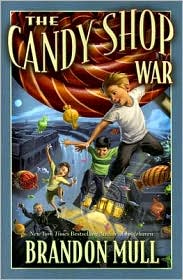
This book takes the old adage "don't take candy from strangers" and turns it into a full-blown, high-risk adventure. A group of four friends start working to earn candy at the candy shop that has just opened. For each task they complete, they receive a treat. At first, they are washing windows for fudge, but eventually the tasked they are asked to complete become more sinister, like stealing artifacts and robbing graves. As the tasks become more risky, the treats become more intriguing: candy that makes you float, candy that changes your appearance, and even candy that allows you to travel through time.
Brandon Mull has a real talent for building suspense. I find it very impressive that I can sit down to read a middle grade novel with young characters and be completely engaged in the action and be anxious for the characters. This is the kind of book that had me continually yelling out “What?!” or “No!” because, ohmygoodness, something crazy was just always happening. And it was awesome.
As I've read more of Mull's books, I've come to really admire the way he crafts the language of his novels. Even though he is writing for younger kids, he doesn't shy away from using a slightly more advanced vocabulary. At the teacher book club meeting for Beyonders, a lot of teachers said that had bothered them. When they asked him about it, Mull explained that he works to find the best word to create the image he sees for his readers, but that he doesn’t really try for challenging vocabulary and doesn’t try to avoid it either. Brandon Mull writes pretty exclusively for young readers, and, obviously, he respects those readers and their right to read good books. A lot of young adult and middle grade authors write down to kids, and that’s really not conducive to writing something worth reading.
The Candy Shop War gets 4 stars. While it is meant for younger audiences, it is a fun read that will keep readers of all ages interested right to the end.
Tuesday, January 31, 2012
Ellie's Book #5: Wintergirls
Wintergirls by Laurie Halse Anderson
*****

How do I write a review of this book?
A week later, I'm still shaken by it.
I read Laurie Halse Anderson's Speak last year and loved it. I cried when I finished it—beautiful and cathartic tears. It hit me in a way that a lot of books don't. It was definitely a five-star read for me.
I've decided that Wintergirls is a five-star read, too, but it took me a long time to make that decision.
Wintergirls is no less powerful than Speak. In fact, I'd say it packs an even stronger punch, although I hate to use such a cliché for such a book, even though I can only think of clichés to describe it. Kick in the gut, brick to the face, hit by a train, knock the wind out of you, rip you open—pick your own description here, that's what this book did to me emotionally. I couldn't put it down even though it was, simply put, terrifying.
The book begins with Lia, a high school senior, being told by her stepmother that Lia's best friend Cassie was found dead in a motel room. Cassie and Lia haven't spoken for six months, which is why Lia didn't answer her phone over the weekend when Cassie tried calling her thirty-three times, and now Lia is haunted by the idea that somehow she is responsible for Cassie's death.
Which sounds simple enough, and rough enough for a book premise.
But.
The reason Cassie and Lia haven't been close is because Cassie's parents made her stop talking to Lia after Lia's second stint in rehab for anorexia. The first stint happened after Lia blacked out while driving Cassie's car because she didn't have enough food in her system and when the paramedics got there her blood pressure and body temperature were only just this side above dead, and Lia's secret was out. Cassie wasn't even scratched and so her secret eating disorder, bulimia, stayed secret and she stayed popular and cut off Lia as "a bad influence."
Until Cassie winds up dead in a motel room.
Honestly, I have never read a book this intense, where the heroine seems absolutely determined to destroy herself slowly and systematically. Nearly every time a food is mentioned, Lia tacks on the number of calories in parentheses. She often speaks in strikethrough font, so you can see the war between her body and her mind as she slowly and determinedly tries to starve herself down to 99, 95, 90, 85 pounds and lower, all while hiding that fact from her family so they won't send her back to the hospital. "I take the cup [of orange juice] from her.My throat wants it my brain wants it my blood wants it my hand does not want this my mouth does not want this."
I had no idea until the very end whether Lia was going to make it or not, and it was a sick-making kind of feeling to watch her spiral downward out of control and not be able to shake her awake, or wave my arms in front of her parents' faces and say "How are you not seeing this?" or heavens, just shove a cupcake down her throat or do something, anything to get her or anyone to see the madness and stop it. It was not a comfortable book to read.
And yet I couldn't put it down. I read it straight through and felt absolutely depressed for most of the rest of the day as I processed it. Anderson's writing style is gripping and immediate and visceral, and you really do feel like you're living through the experience yourself, which, as I said, is not a comfortable thing. But there is no doubt it is well written.
I don't know if I liked this book or not. I do know I won't forget it any time soon.
And I think that I'm going to have to recommend it to people to read. Not like Speak, which I think everyone should read, period, no exceptions. But I think that some people should take the opportunity to read Wintergirls because even though it's not a comfortable experience, it is a powerful experience, and one that will change you.
(And if you do read it, I'd love to discuss it with you.)
*****

How do I write a review of this book?
A week later, I'm still shaken by it.
I read Laurie Halse Anderson's Speak last year and loved it. I cried when I finished it—beautiful and cathartic tears. It hit me in a way that a lot of books don't. It was definitely a five-star read for me.
I've decided that Wintergirls is a five-star read, too, but it took me a long time to make that decision.
Wintergirls is no less powerful than Speak. In fact, I'd say it packs an even stronger punch, although I hate to use such a cliché for such a book, even though I can only think of clichés to describe it. Kick in the gut, brick to the face, hit by a train, knock the wind out of you, rip you open—pick your own description here, that's what this book did to me emotionally. I couldn't put it down even though it was, simply put, terrifying.
The book begins with Lia, a high school senior, being told by her stepmother that Lia's best friend Cassie was found dead in a motel room. Cassie and Lia haven't spoken for six months, which is why Lia didn't answer her phone over the weekend when Cassie tried calling her thirty-three times, and now Lia is haunted by the idea that somehow she is responsible for Cassie's death.
Which sounds simple enough, and rough enough for a book premise.
But.
The reason Cassie and Lia haven't been close is because Cassie's parents made her stop talking to Lia after Lia's second stint in rehab for anorexia. The first stint happened after Lia blacked out while driving Cassie's car because she didn't have enough food in her system and when the paramedics got there her blood pressure and body temperature were only just this side above dead, and Lia's secret was out. Cassie wasn't even scratched and so her secret eating disorder, bulimia, stayed secret and she stayed popular and cut off Lia as "a bad influence."
Until Cassie winds up dead in a motel room.
Honestly, I have never read a book this intense, where the heroine seems absolutely determined to destroy herself slowly and systematically. Nearly every time a food is mentioned, Lia tacks on the number of calories in parentheses. She often speaks in strikethrough font, so you can see the war between her body and her mind as she slowly and determinedly tries to starve herself down to 99, 95, 90, 85 pounds and lower, all while hiding that fact from her family so they won't send her back to the hospital. "I take the cup [of orange juice] from her.
I had no idea until the very end whether Lia was going to make it or not, and it was a sick-making kind of feeling to watch her spiral downward out of control and not be able to shake her awake, or wave my arms in front of her parents' faces and say "How are you not seeing this?" or heavens, just shove a cupcake down her throat or do something, anything to get her or anyone to see the madness and stop it. It was not a comfortable book to read.
And yet I couldn't put it down. I read it straight through and felt absolutely depressed for most of the rest of the day as I processed it. Anderson's writing style is gripping and immediate and visceral, and you really do feel like you're living through the experience yourself, which, as I said, is not a comfortable thing. But there is no doubt it is well written.
I don't know if I liked this book or not. I do know I won't forget it any time soon.
And I think that I'm going to have to recommend it to people to read. Not like Speak, which I think everyone should read, period, no exceptions. But I think that some people should take the opportunity to read Wintergirls because even though it's not a comfortable experience, it is a powerful experience, and one that will change you.
(And if you do read it, I'd love to discuss it with you.)
Saturday, January 21, 2012
Meg's 5th Read: I Am Not a Serial Killer, by Dan Wells
Oh, where to begin.

Let's see... I first heard about this book on a blog that was listing its pick for the best fiction by LDS authors in 2010. I read the synopses given and added several of them to my to-read list, and then promptly forgot all about them. A while back, when I was picking my next selection via Goodreads and random.org, this one came up. I picked it up from the library, and it wasn't until I read the author bio and saw that Dan Wells lives in Orem that I remembered where I had heard of this book. That said, the fact that the author is LDS is the only Mormon thing about this book. (Which is probably a good thing, because LDS-themed fiction isn't really my favorite. I have read some that I really enjoyed, but I don't usually go out of my way to read books from that genre.)
The basic plot of this young adult book (which is the first in a trilogy) involves a young man, John Wayne Cleaver, who has been clinically diagnosed with sociopathy. In addition to that, he has a fascination bordering on obsession with serial killers. I don't need to spell out for you what kind of combination that is. Fortunately, John also has a strong desire to keep himself from becoming the type of monster it seems he is fated to be. This strong desire has led him to set up strict rules for himself about his interactions with other people and his daily behavior. Sticking to these rules is essential.
John lives in a small town, Clayton, with his mother, who happens to run the town's mortuary along with her twin sister. When a serial killer strikes Clayton, it's no surprise that John's interest is piqued-- perhaps to an unhealthy extent. John ultimately figures out who the killer is, and knows that he is in a unique position to be able to stop him... but also knows that he needs to do so without unleashing the monster within. Succeeding on both accounts turns out to be a lot more difficult than John anticipates.
So... what do I rate this book? This is where it gets difficult. I literally bounced back and forth between liking and hating it, pretty much every chapter. I guess I'll start with what I didn't like.
First, I knocked one star off after the fourth or fifth time I saw a grammatical error. There weren't TONS of mistakes, but seriously, where was the copy editor? I think I am more particular than the average reader, but then again, I think all of the readers of this blog would have been just as annoyed as I was to see the kinds of minor errors that made it to print. Moving on...
A second star gets knocked off because, while I have to give the author credit for tackling the task of writing from the perspective of a 15-year-old sociopath, there were just too many times when it felt forced and I didn't believe it. I think that a lot of that came from the inexperience of the author. This is his first book, after all. I got the feeling that this same story, written by someone with a bit more experience, would have been flawless in this respect. Sorry, Mr. Wells. I anticipate your future books to be even better though, so I don't feel too bad for saying this.
Finally, I think I have to knock one more star off just because of all the times that I almost stopped reading it. This happened for several reasons. One, it is a bit dark in some places. Remember, you are reading the thoughts of a teenager who is obsessed with death... and not just death, murder. At some points I just thought to myself, OK, I'm over it. And to be honest, I think the main reason I picked it back up again after one of those moments is that I wanted to be able to give it an honest review on this blog. :)
Another reason that I almost gave up on it is that Wells brings a supernatural element into the story that (1) I wasn't expecting AT ALL, and (2) I wasn't a big fan of. By the end, I had to admit that it was an OK choice on his part, but I still wasn't super happy about it.
On the other hand, I obviously kept reading, and here are my reasons for doing so. One is that it does have some good humor in it. I chuckled inside my head quite a few times-- especially at some choice dialog between John and his nerdy friend, Max. Additionally, once the action really got going, I definitely got sucked in and had to know how it ended. There were some really tense moments. Wells definitely did a good job with those.
So, all in all, it was an entertaining read. I think, looking back, that I have to say my "like" for the book outweighs my dislike. I didn't love it, and it wasn't so blah that I'd take it or leave it, so it gets three stars from me.
If you are interested, here's what another reviewer had to say, from FantasyBookCritic.blogspot.com:
Title: I Am Not a Serial Killer
Author: Dan Wells
Published: 2010
272 pages

Let's see... I first heard about this book on a blog that was listing its pick for the best fiction by LDS authors in 2010. I read the synopses given and added several of them to my to-read list, and then promptly forgot all about them. A while back, when I was picking my next selection via Goodreads and random.org, this one came up. I picked it up from the library, and it wasn't until I read the author bio and saw that Dan Wells lives in Orem that I remembered where I had heard of this book. That said, the fact that the author is LDS is the only Mormon thing about this book. (Which is probably a good thing, because LDS-themed fiction isn't really my favorite. I have read some that I really enjoyed, but I don't usually go out of my way to read books from that genre.)
The basic plot of this young adult book (which is the first in a trilogy) involves a young man, John Wayne Cleaver, who has been clinically diagnosed with sociopathy. In addition to that, he has a fascination bordering on obsession with serial killers. I don't need to spell out for you what kind of combination that is. Fortunately, John also has a strong desire to keep himself from becoming the type of monster it seems he is fated to be. This strong desire has led him to set up strict rules for himself about his interactions with other people and his daily behavior. Sticking to these rules is essential.
John lives in a small town, Clayton, with his mother, who happens to run the town's mortuary along with her twin sister. When a serial killer strikes Clayton, it's no surprise that John's interest is piqued-- perhaps to an unhealthy extent. John ultimately figures out who the killer is, and knows that he is in a unique position to be able to stop him... but also knows that he needs to do so without unleashing the monster within. Succeeding on both accounts turns out to be a lot more difficult than John anticipates.
So... what do I rate this book? This is where it gets difficult. I literally bounced back and forth between liking and hating it, pretty much every chapter. I guess I'll start with what I didn't like.
First, I knocked one star off after the fourth or fifth time I saw a grammatical error. There weren't TONS of mistakes, but seriously, where was the copy editor? I think I am more particular than the average reader, but then again, I think all of the readers of this blog would have been just as annoyed as I was to see the kinds of minor errors that made it to print. Moving on...
A second star gets knocked off because, while I have to give the author credit for tackling the task of writing from the perspective of a 15-year-old sociopath, there were just too many times when it felt forced and I didn't believe it. I think that a lot of that came from the inexperience of the author. This is his first book, after all. I got the feeling that this same story, written by someone with a bit more experience, would have been flawless in this respect. Sorry, Mr. Wells. I anticipate your future books to be even better though, so I don't feel too bad for saying this.
Finally, I think I have to knock one more star off just because of all the times that I almost stopped reading it. This happened for several reasons. One, it is a bit dark in some places. Remember, you are reading the thoughts of a teenager who is obsessed with death... and not just death, murder. At some points I just thought to myself, OK, I'm over it. And to be honest, I think the main reason I picked it back up again after one of those moments is that I wanted to be able to give it an honest review on this blog. :)
Another reason that I almost gave up on it is that Wells brings a supernatural element into the story that (1) I wasn't expecting AT ALL, and (2) I wasn't a big fan of. By the end, I had to admit that it was an OK choice on his part, but I still wasn't super happy about it.
On the other hand, I obviously kept reading, and here are my reasons for doing so. One is that it does have some good humor in it. I chuckled inside my head quite a few times-- especially at some choice dialog between John and his nerdy friend, Max. Additionally, once the action really got going, I definitely got sucked in and had to know how it ended. There were some really tense moments. Wells definitely did a good job with those.
So, all in all, it was an entertaining read. I think, looking back, that I have to say my "like" for the book outweighs my dislike. I didn't love it, and it wasn't so blah that I'd take it or leave it, so it gets three stars from me.
If you are interested, here's what another reviewer had to say, from FantasyBookCritic.blogspot.com:
"Part serial killer thriller and part supernatural horror with black humor, coming-of-age and teen angst mixed in, “I Am Not A Serial Killer” is like a cross between Dexter, Jeepers Creepers, and a YA dramedy..."INFO:
Title: I Am Not a Serial Killer
Author: Dan Wells
Published: 2010
272 pages
Subscribe to:
Posts (Atom)