Slowly but surely, I will catch up on my reviews. Unfortunately, I don't think I will complete 52 books by next Tuesday. I'm reading the 50th now. But I'm not crushed-- I fulfilled the spirit of my goal and read a LOT this year.
Book 48 was Graceling by Kristen Cashore. I give it 4.5 stars.
In the world of Graceling, some individuals are born with two different colored eyes. This is the mark of a Graceling, one who has a gift or special ability, also known as a Grace. Graces can be anything from mind reading, to being exceptionally good at climbing trees, to being an excellent swimmer, to being a super human fighter. Gracelings usually aren't born with two different colored eyes-- this happens sometime after birth and reveals the Graceling, but sometimes it takes even longer for the Grace to make itself known. Parents and others must be watchful to discover the nature of the Grace. In some areas, Gracelings are feared or shunned; in others, revered.
Katsa, our main character, is believed to have the Grace of killing. In other words, don't mess with her. She is the niece of a king and has been essentially taken as his property, to do his dirty work throughout his and other kingdoms. If the king wants someone punished, he sends Katsa. She comes to a deeper understanding of what her Grace actually is part way through the book, and I'm glad the author chose to clarify/modify it. I wasn't altogether satisfied with the idea of her Grace simply being a superhuman ability to kill.
The main story of the book involves Katsa and her newfound friend and fellow Graceling Po, as they work together to save Po's niece from the clutches of a very bad man. There is much action, intrigue, and yes, some love.
It took me a bit, but I really liked the world Cashore created. I dove into the story and couldn't wait to find out how it would resolve. The one thing I am slightly disappointed about, after finishing, is that it appears the second book in the Graceling Ream series has nothing to do with Katsa and Po. I really grew to like those two and I was eager to read a sequel that continued their adventures together. Oh well.
The strongest criticism I have read in regards to this book deals with what some perceive as Katsa's anti-man/anti-marriage attitude. I can understand where these readers are coming from, but I don't agree whole-heartedly. In this book, Katsa has spent most of her life at the mercy and whims of her uncle, the king. She is, for all practical purposes, his property, and believes she must do as he bids. This means using her Grace to punish people with whom the king disagrees, whether they are in the wrong or not.
Part way through the book, with the help of Po, Katsa comes to realize that, in part because of her powerful Grace, she doesn't have to submit herself to the king. I don't think it is a spoiler to say that she decides to leave the king's service. She finally, for the first time in her life, feels like she is in control of herself. She begins to learn who she really is and make her own choices. This freedom strengthens her resolve, which she apparently has held since she was young, to never marry. Even after falling in love, Katsa refuses to agree to marriage. She ends up in what could probably be called an open relationship, and I think these plot choices are what angered some readers.
I disagree with the criticism for a few reasons. First, while the book doesn't exactly spell it out, it seems that the society Cashore created is meant to be similar to a medieval society, at least as far as the standing of women goes. They are more property than anything else. Because of the way Katsa has lived under the thumb of her uncle, she has never wanted to deliberately give herself as property to another man, even as a wife. This attitude is prevalent throughout the book and forms a pretty big part of Katsa's personaity, but I wouldn't characterize it as anti-marriage. I would say it is anti-subjugation of women. If Katsa didn't have to worry about being used and controlled, she wouldn't have the aversion to marriage that she has. It's not that she hates men, after all, she does fall in love. It's that she wants to be in control of herself and her Grace. Who can blame her for that? I don't think Cashore was trying to make a statement about modern day marriage at all, as some readers have inferred.
I'd definitely recommend this if you enjoy YA fantasy fiction. I plan to read the next two books.
Showing posts with label fantasy. Show all posts
Showing posts with label fantasy. Show all posts
Thursday, December 27, 2012

Monday, May 21, 2012
17: Warbreaker by Brandon Sanderson
My first venture into the writing of Brandon Sanderson, Warbreaker is a great novel. I love Sanderson's writing style, and I will definitely be reading more of his work in the future. I can see why he was chosen to continue Robert Jordan's unfinished series. Speaking of, for any Wheel of Time readers out there who have yet to reach his contribution to the series, I give a full vote of confidence that it's going to be awesome. For the WoT readers who have read his addition, feel free to let me know in the comments what you thought. I need to finish that series one of these days...
But back to the book. Sanderson created a completely new world in this novel, which isn't the easiest thing to do if you've read much fantasy. Sanderson nails it. When I first read the description of this book, I admit I was a bit hesitant. It just sounded kind of weird and a little too far-fetched. I mean, yeah, most fantasy worlds are going to be far-fetched, but this one seemed pretty out there. Fortunately, Sanderson is amazing and pulled it off.
Here is a brief sneak peak, from Goodreads:
Warbreaker is the story of two sisters, who happen to be princesses, the God King one of them has to marry, the lesser god who doesn’t like his job, and the immortal who’s still trying to undo the mistakes he made hundreds of years ago.
Their world is one in which those who die in glory return as gods to live confined to a pantheon in Hallandren’s capital city and where a power known as BioChromatic magic is based on an essence known as breaththat can only be collected one unit at a time from individual people.
By using breath and drawing upon the color in everyday objects, all manner of miracles and mischief can be accomplished. It will take considerable quantities of each to resolve all the challenges facing Vivenna and Siri, princesses of Idris; Susebron the God King; Lightsong, reluctant god of bravery, and mysterious Vasher, the Warbreaker.
Right? Yeah. The description didn't immediately grab me. But once I started reading, it didn't take long at all for me to get sucked in. The chapters rotate perspectives and I think I was most engaged in Siri's life, though Lightsong comes in a close second. Once you near the end and get close to the resolution of everything, it really gets exciting. I don't want to say too much. Just read it. A resounding four stars.
Friday, May 11, 2012
Daughter of Smoke and Bone-- Laini Taylor
After the review and recommendation of Kristen Shill, I added Daughter of Smoke and Bone to my to-read list on Goodreads. I am so glad I did. I needed a little YA action in my life, and this was a great read. It wasn't at all what I expected, and it actually took me a good bit to really get into the story. But once I did, I was in. Laini Taylor has crafted quite an interesting world, and I can't wait to see what happens in the next book. What is Karou going to do next?! Is Brimstone (and the other chimaera) really dead?! Etc.
Note: While I can call this a YA novel without reservations, I would recommend it for the older side of YA. It's a bit darker and a bit more mature than some of the YA I've read recently.
This was my 16th read of 2012. I give it four stars.
Note: While I can call this a YA novel without reservations, I would recommend it for the older side of YA. It's a bit darker and a bit more mature than some of the YA I've read recently.
This was my 16th read of 2012. I give it four stars.
Monday, April 30, 2012
Ellie's Book #6: The Princess Bride
Yes, I'm back. The cross-country move went well but the dust is still settling so I'll be playing catch-up for a bit.
The Princess Bride, by William Goldman
*****

I should explain. As you may have caught on, I'm a bit of a movie geek. Yeah. I'm the one who can rattle off actor resumes and Bacon scores faster than IMDb. If you don't understand a comment I just made, there's about a 75% chance that it's a quote from a movie (and an 80% chance in that case that it's a movie you've never heard of, let alone seen). I, like my father before me, stay until the end of the movie in the theater, not to see if there are any extra scenes, but to read the credits. (The advent of extra scenes, however, has really helped to convince the people with and around us not to bug us to leave early. True story: my parents were once asked to leave a movie theater. They had gone to a late showing of the Disney classic Alice in Wonderland—the real one, not that Tim Burton nonsense—and were the last people left in the theater because my dad was watching the credits. The cleaning staff just wanted to go home so they asked my parents to leave.)
But I digress.
The Princess Bride was one of the first movies I remember seeing in the theater. There was an old dollar theater near our house called The Arcade, and that's where I remember seeing such movies as The Rescuers, Peter Pan, Lady and the Tramp (I chose to see that for my birthday movie, probably when I was three or four, and the projector broke), The Little Mermaid and, of course, The Princess Bride. I loved that movie. When it came out on VHS my aunt got it, whereupon she was the most-requested babysitter at our house in spite of the fact that she lived nearly an hour away. One of the best days of my young life was when The Princess Bride had its network TV broadcast premiere and my dad recorded it so that now we had our own family copy (the downside was that this was the copy I was most familiar with growing up and so I was surprised when I went to college and got my own copy of the movie and there were parts in there I didn't recognize because the TV version had been edited to run in the time allotted. I made up for it, though, and three years later actually became the campus champion of Princess Bride trivia. No, I am not kidding. My prize: a Princess Bride frisbee full of gummy worms, which the event organizers called "shrieking eels." The reason I chose that prize was because I already had a copy of the movie, the book and the soundtrack, which is not surprising when you consider how I wound up knowing all that trivia in the first place).
But (coming back to the aforementioned confusion) my mom had raised a question when I was little that had always made me wonder. In the movie, when the grandfather starts reading, he says, "The Princess Bride, by S. Morgenstern. Chapter One." But in the credits, my mom pointed out that it says it's based on William Goldman's book. Which is the real author?
The real author, of course, is William Goldman. But his book is ostensibly "the good parts version"—that is, he's writing it as though he's abridging S. Morgenstern's longer book, just keeping the good parts and getting rid of all the boring political satire that Morgenstern supposedly stuffed into it. But it's done well enough that when I first read this book in the sixth grade (no, this isn't a children's book), I really did think there was an unabridged version floating around out there. I'm not sure how long it took me to figure out the truth, but much longer than it probably should have. (I'm guessing somewhere around my junior year of high school is when I finally accepted the fact that I would never get to read the hat-packing scenes. It's kind of like learning about Santa.)
But coming to the book itself—it is simply wonderful. The movie, excellent as it is, doesn't half do it justice. I still, to this day, am disappointed while reading the passages from the Zoo of Death because they're not in the movie and it would have been so cool to see them! And then I remember that I don't like seeing pictures or video or real life of snakes or spiders and think, well, okay, the Pit of Despair will do. But I still use the Zoo of Death passages as great examples of suspense and good writing in classes. I also love how much more back story you get with the characters (young Inigo listening to Domingo and Yeste in particular gives me the giggles), and I have to say that it's much, much easier to understand the dialogue in the movie's swordfight scene once you've read the book.
William Goldman is an excellent writer in every sense. You're probably familiar with his work even if you don't realize it—he's an amazing and successful screenwriter as well. Think Butch Cassidy and the Sundance Kid, All the President's Men, Misery, Maverick, and of course The Princess Bride. But this book is a marvel of creation and of construction. Everything fits seamlessly together, especially the way he uses the frame story of the abridgment and his father first reading the book to him when he was sick as a child to actually help tell the story. Writers should study this book to see how a master crafts a story.
It's come to the point where I don't know for sure which I've done more, read the book or watch the movie. But it had been a long time since my last re-read (I know because I found a ticket stub to Harry Potter and the Prisoner of Azkaban tucked inside my copy when I opened it), and I needed something familiar, comforting and lighthearted-but-not-stupid after the emotional wringer that was Wintergirls. The Princess Bride did the trick very nicely, like a long conversation with an old friend, the kind where you both end up laughing so hard you can barely breathe.
All I can say is, if you have never read this book, please do yourself a favor and pick up a copy as soon as possible. It is one of the most well-crafted novels I have ever read, and it's entertaining and witty on top of it, which, really, is everything a book ought to be. Five stars.
The Princess Bride, by William Goldman
*****

So begins one of my favorite books, The Princess Bride, by William Goldman. This book has been a source of both happiness and confusion to me since I was a young child.This is my favorite book in all the world, though I have never read it.
I should explain. As you may have caught on, I'm a bit of a movie geek. Yeah. I'm the one who can rattle off actor resumes and Bacon scores faster than IMDb. If you don't understand a comment I just made, there's about a 75% chance that it's a quote from a movie (and an 80% chance in that case that it's a movie you've never heard of, let alone seen). I, like my father before me, stay until the end of the movie in the theater, not to see if there are any extra scenes, but to read the credits. (The advent of extra scenes, however, has really helped to convince the people with and around us not to bug us to leave early. True story: my parents were once asked to leave a movie theater. They had gone to a late showing of the Disney classic Alice in Wonderland—the real one, not that Tim Burton nonsense—and were the last people left in the theater because my dad was watching the credits. The cleaning staff just wanted to go home so they asked my parents to leave.)
But I digress.
The Princess Bride was one of the first movies I remember seeing in the theater. There was an old dollar theater near our house called The Arcade, and that's where I remember seeing such movies as The Rescuers, Peter Pan, Lady and the Tramp (I chose to see that for my birthday movie, probably when I was three or four, and the projector broke), The Little Mermaid and, of course, The Princess Bride. I loved that movie. When it came out on VHS my aunt got it, whereupon she was the most-requested babysitter at our house in spite of the fact that she lived nearly an hour away. One of the best days of my young life was when The Princess Bride had its network TV broadcast premiere and my dad recorded it so that now we had our own family copy (the downside was that this was the copy I was most familiar with growing up and so I was surprised when I went to college and got my own copy of the movie and there were parts in there I didn't recognize because the TV version had been edited to run in the time allotted. I made up for it, though, and three years later actually became the campus champion of Princess Bride trivia. No, I am not kidding. My prize: a Princess Bride frisbee full of gummy worms, which the event organizers called "shrieking eels." The reason I chose that prize was because I already had a copy of the movie, the book and the soundtrack, which is not surprising when you consider how I wound up knowing all that trivia in the first place).
But (coming back to the aforementioned confusion) my mom had raised a question when I was little that had always made me wonder. In the movie, when the grandfather starts reading, he says, "The Princess Bride, by S. Morgenstern. Chapter One." But in the credits, my mom pointed out that it says it's based on William Goldman's book. Which is the real author?
The real author, of course, is William Goldman. But his book is ostensibly "the good parts version"—that is, he's writing it as though he's abridging S. Morgenstern's longer book, just keeping the good parts and getting rid of all the boring political satire that Morgenstern supposedly stuffed into it. But it's done well enough that when I first read this book in the sixth grade (no, this isn't a children's book), I really did think there was an unabridged version floating around out there. I'm not sure how long it took me to figure out the truth, but much longer than it probably should have. (I'm guessing somewhere around my junior year of high school is when I finally accepted the fact that I would never get to read the hat-packing scenes. It's kind of like learning about Santa.)
But coming to the book itself—it is simply wonderful. The movie, excellent as it is, doesn't half do it justice. I still, to this day, am disappointed while reading the passages from the Zoo of Death because they're not in the movie and it would have been so cool to see them! And then I remember that I don't like seeing pictures or video or real life of snakes or spiders and think, well, okay, the Pit of Despair will do. But I still use the Zoo of Death passages as great examples of suspense and good writing in classes. I also love how much more back story you get with the characters (young Inigo listening to Domingo and Yeste in particular gives me the giggles), and I have to say that it's much, much easier to understand the dialogue in the movie's swordfight scene once you've read the book.
William Goldman is an excellent writer in every sense. You're probably familiar with his work even if you don't realize it—he's an amazing and successful screenwriter as well. Think Butch Cassidy and the Sundance Kid, All the President's Men, Misery, Maverick, and of course The Princess Bride. But this book is a marvel of creation and of construction. Everything fits seamlessly together, especially the way he uses the frame story of the abridgment and his father first reading the book to him when he was sick as a child to actually help tell the story. Writers should study this book to see how a master crafts a story.
It's come to the point where I don't know for sure which I've done more, read the book or watch the movie. But it had been a long time since my last re-read (I know because I found a ticket stub to Harry Potter and the Prisoner of Azkaban tucked inside my copy when I opened it), and I needed something familiar, comforting and lighthearted-but-not-stupid after the emotional wringer that was Wintergirls. The Princess Bride did the trick very nicely, like a long conversation with an old friend, the kind where you both end up laughing so hard you can barely breathe.
All I can say is, if you have never read this book, please do yourself a favor and pick up a copy as soon as possible. It is one of the most well-crafted novels I have ever read, and it's entertaining and witty on top of it, which, really, is everything a book ought to be. Five stars.
Wednesday, February 29, 2012
The Candy Shop War
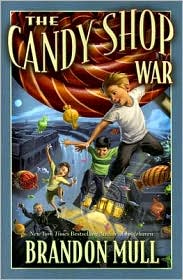
This book takes the old adage "don't take candy from strangers" and turns it into a full-blown, high-risk adventure. A group of four friends start working to earn candy at the candy shop that has just opened. For each task they complete, they receive a treat. At first, they are washing windows for fudge, but eventually the tasked they are asked to complete become more sinister, like stealing artifacts and robbing graves. As the tasks become more risky, the treats become more intriguing: candy that makes you float, candy that changes your appearance, and even candy that allows you to travel through time.
Brandon Mull has a real talent for building suspense. I find it very impressive that I can sit down to read a middle grade novel with young characters and be completely engaged in the action and be anxious for the characters. This is the kind of book that had me continually yelling out “What?!” or “No!” because, ohmygoodness, something crazy was just always happening. And it was awesome.
As I've read more of Mull's books, I've come to really admire the way he crafts the language of his novels. Even though he is writing for younger kids, he doesn't shy away from using a slightly more advanced vocabulary. At the teacher book club meeting for Beyonders, a lot of teachers said that had bothered them. When they asked him about it, Mull explained that he works to find the best word to create the image he sees for his readers, but that he doesn’t really try for challenging vocabulary and doesn’t try to avoid it either. Brandon Mull writes pretty exclusively for young readers, and, obviously, he respects those readers and their right to read good books. A lot of young adult and middle grade authors write down to kids, and that’s really not conducive to writing something worth reading.
The Candy Shop War gets 4 stars. While it is meant for younger audiences, it is a fun read that will keep readers of all ages interested right to the end.
Kristen's #5: Daughter of Smoke and Bone


I had several people recommend this book to me within the space of a few weeks. And with very good reason. Daughter of Smoke and Bone was the only YA book to make Amazon's Top 10 of 2011, and it was the #1 YA book of 2011.
I'll preface this by saying I don't read or enjoy most YA lit. I read YA when I was myself a young adult and I liked it well enough then. Daughter of Smoke and Bone is far superior to pretty much any piece of YA lit I've ever read. Good writing is just plain good writing, regardless of the relative age of the intended audience.
Karou, the main protagonist, is a young woman with aquamarine hair that grows that way naturally who attends art school in Prague. The very substance of her being is a mystery. Karou puzzles her friends by going off on unexplained "errands" with practically no notice at all, disappearing sometimes for several days at a time. She has hamsas tattooed into her palms that have been there as long as she can remember.
The writing is luminous. The author, Laini Taylor (who as you can see sports some psychedelic locks herself) clearly has a sense for crafting turns of phrase. Her metaphors are complex and intricate. It's the first young adult novel I've had to actually look up the meaning of words, but yet the big words don't come off as trying too hard as they do in the Vampmeyer books.
The main conflict could come off as cliché (angles vs. demons), but it doesn't. And Karou is everything that Bella of Vampmeyer fame is not. Karou is self-assured, strong, trained in martial arts, witty, talented, independent, and beautiful. Well, I suppose Bella is supposed to be fabulously beautiful given that her name is Beautiful Swan and all but whatevs. (Sorry, I really didn't intend to turn this into a Twilight lampoon. But really. Karou is the anti-Bella. And it's awesome).
Daughter of Smoke and Bone is part fantasy and part mythology. Reality shifts as portals to other realities open. Oh, it's just good.
Be warned that it's the first book of a trilogy, and the followup books are still in the works (tentative release of book two in fall of 2012). I was glad that I knew that before I read the book so I wasn't shaking my fists at the sky with how the book ends. It's fabulous, but it's definitely a cliffhanger ending that leaves a great deal unresolved. I await the next installment with eagerness.
I don't really have much to say except that you absolutely should read it. I unreservedly recommend this even if you don't typically like YA lit or books with fantasy/sci-fi elements. The writing is that good.
I give this five stars without even batting an eye.
Subscribe to:
Posts (Atom)